
Scenario 2 · Scope out the competition
Want to know what a competitor is running on Meta/TikTok, what they're selling, and how they go viral? One sentence — AI pulls real data + a complete AARRR funnel + a directly actionable playbook.
What this scenario solves
Want to know what a competitor is doing, how well it's working, and why they're winning? AI digs through their Meta ads, public TikTok data, and website, then organizes it into a complete "what they're doing + what you can learn" report. No account connection needed, so new users can try it right away.
How to use it
Analyze the ads and marketing strategy for this competitor: [company name or URL]What the report roughly looks like (using Cider as an example)
Take analyzing the fast-fashion brand Cider as an example: the report AI delivers has 7 chapters — don't let the count fool you, each chapter is dense with information. Chapter 4, the TikTok real-time data, is the most convincing hard currency in the whole report:
| Chapter | Content |
|---|---|
| 1. Company Overview | Founding · valuation · funding · business model · core USP |
| 2. Brand Positioning & Messaging | Brand pillars + on-site conversion tactics |
| 3. Advertising Channels & Strategy | Channel tiers (Meta / TikTok / Pinterest / OOH, etc.) + creative strategy |
| 4. TikTok Commerce Performance | Real GMV / units / affiliate data, pulled live |
| 5. Growth Funnel Breakdown | Full AARRR funnel decomposition |
| 6. Strengths & Vulnerabilities | Wins + weaknesses, both directions |
| 7. Actionable Takeaways | The playbook you can copy directly |
The biggest difference from generic AI: it pulls real data
This part matters. AI doesn't analyze competitors by going "I'm guessing they're probably doing..." — it goes to public platforms like TikTok Shop and pulls real transaction data. In other words, the numbers below aren't estimates — they're live data pulled straight from the platform:
AI also pulls the top-selling product detail, so you can see exactly which of the competitor's SKUs are driving volume and which styles are worth benchmarking against:
| Product | Units | GMV | Affiliates |
|---|---|---|---|
| Sleeveless Wide Leg Overalls | 226K | $6.3M | 3,433 |
| Stretchy Wide Leg Pants (12 colors) | 108K | $2.25M | 1,518 |
| 2-Piece Sweater Dress Set | 86K | $5.04M | 2,504 |
| Corduroy Floral Button Romper | 41K | $1.1M | 1,169 |
| Leopard Denim Overalls | 19K | $998K | 1,415 |
The complete growth funnel (AARRR)
AI also uses the classic AARRR funnel framework to take apart the competitor's entire growth machine — from acquisition, activation, retention, and revenue through to referral, telling you specifically "what they're doing" at each stage:
Chapter 7 is the part most worth reading
Chapters 1-6 are mostly "what they're doing." It's not until Chapter 7 that AI starts telling you "what you can do about it" — reverse-engineering the competitor's strategy into homework you can copy directly, each item with a specific action and the logic for why it wins:
- Beat them on quality + CX — their biggest soft spot is returns friction and inconsistent quality (Trustpilot 3.8). Match the price + speed + better quality = win the repeat purchase
- Copy their affiliate creator engine — their 25K+ creator army is their core engine. Aggressively recruit TikTok Shop affiliates with competitive commission rates
- Intercept "is X legit?" search intent — lots of people search whether a competitor is trustworthy before buying. Place content + social proof at this decision point and you capture them
- Use mood-based navigation — their "Pick A Mood" UX is proven to work (50%+ user adoption). Add an emotional/occasion layer alongside traditional categories
- UGC as your primary ad creative — shift budget from studio shoots to creator relationships (more native + cheaper + higher CTR)
- Seize the shipping-window gap — they promise 4 days, so if you deliver in 2-3 days that's a clear differentiating selling point
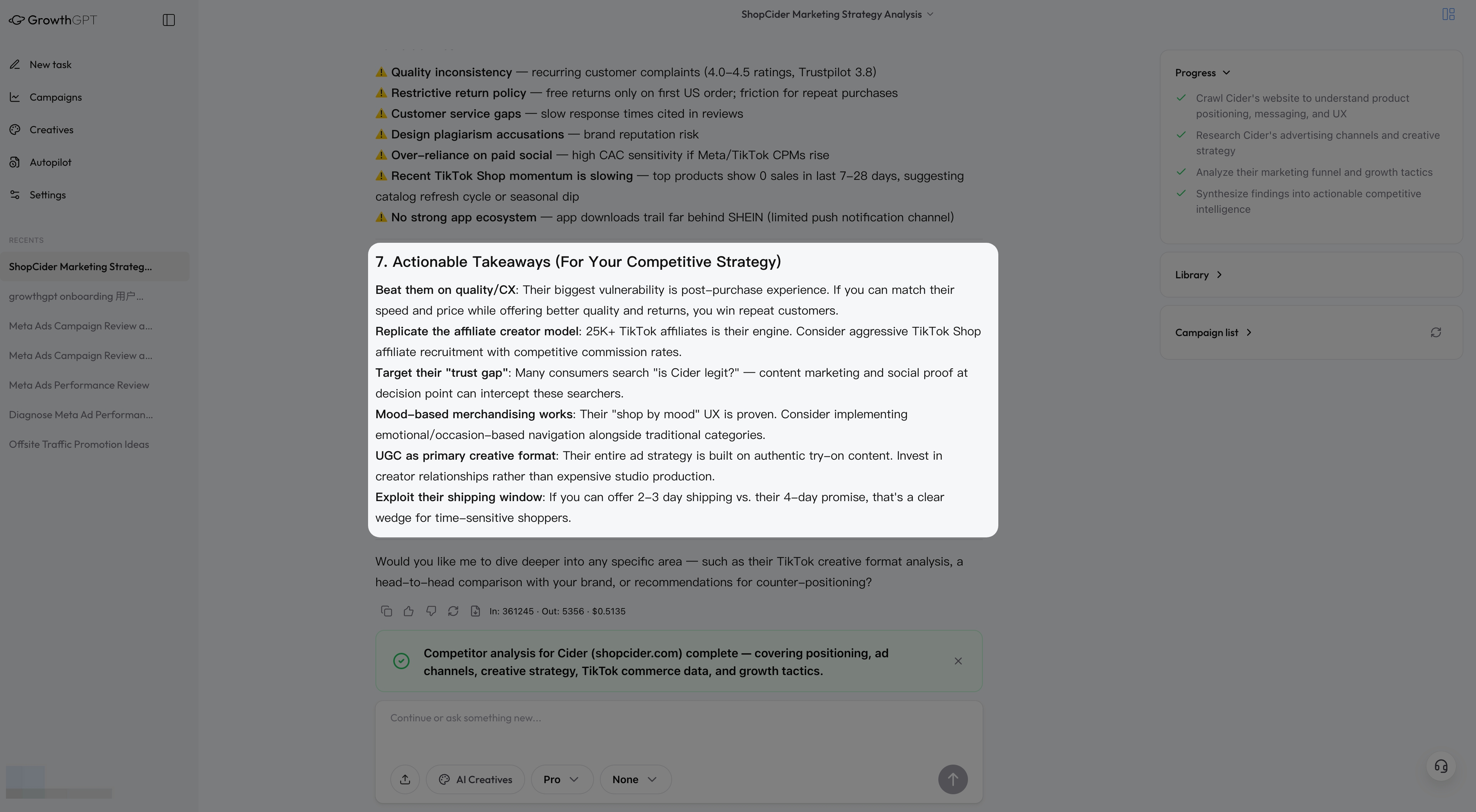
Chapter 7 · Actionable Takeaways (anonymized) · AI hands you a directly executable action list — this is the most valuable part of the whole report
5 universal follow-ups
- "Turn chapter X into a 1-page deck outline for my boss"
- "For strategy A in there, give me a 14-day execution plan"
- "If my budget is only $X/month, which 3 things should I do first?"
- "My product is [description] — which of these suggestions don't apply, and why?"
- "Give me a 4-week experiment plan for the next month — one hypothesis and one metric per week"