5 Things Every AI Ad Tool Claims — And the Questions They Hope You Never Ask
A framework for evaluating AI ad tools by what they actually do, not what they say on the landing page. Five claims you'll see on every website — and the five follow-up questions that separate marketing copy from real capability.
The Pattern
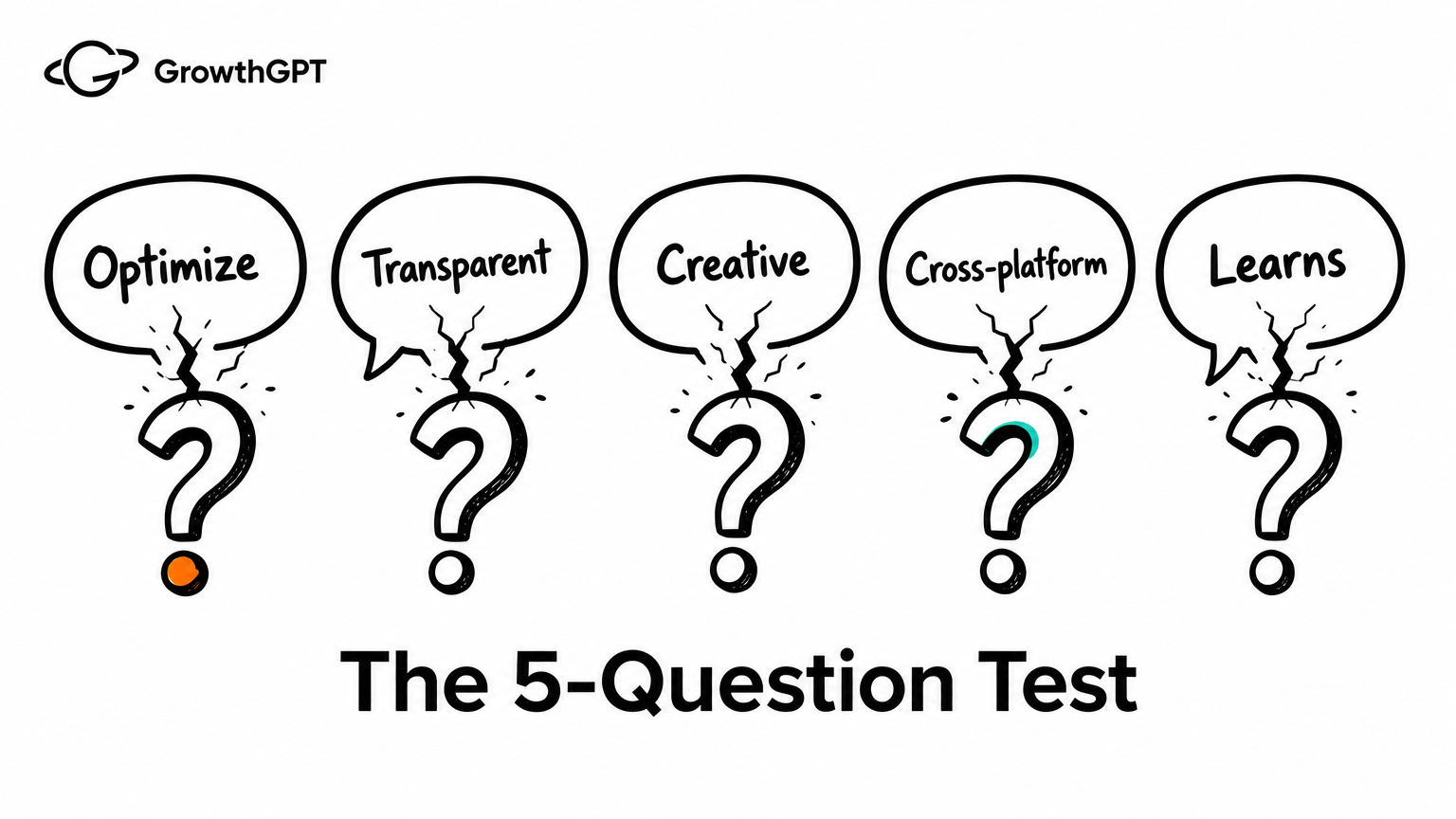
Open any AI ad tool's website. You'll find the same five claims, almost word for word:
- "Our AI optimizes your ads automatically."
- "Full transparency — you're always in control."
- "AI-powered creative at scale."
- "Works across all major platforms."
- "The system learns and improves over time."
None of these are lies, exactly. But none of them mean what you think they mean — until you ask the right follow-up question.
This article gives you those five questions. Use them on us. Use them on anyone.
The 5-Question AI Ad Tool Test
Test 1 — "Our AI optimizes your ads automatically."
The Claim: The system watches your campaigns and makes smart adjustments without manual intervention.
The Reality: Most "automatic optimization" is a set of static rules: if CPA > $X, pause. That's an Excel formula with a nicer UI.
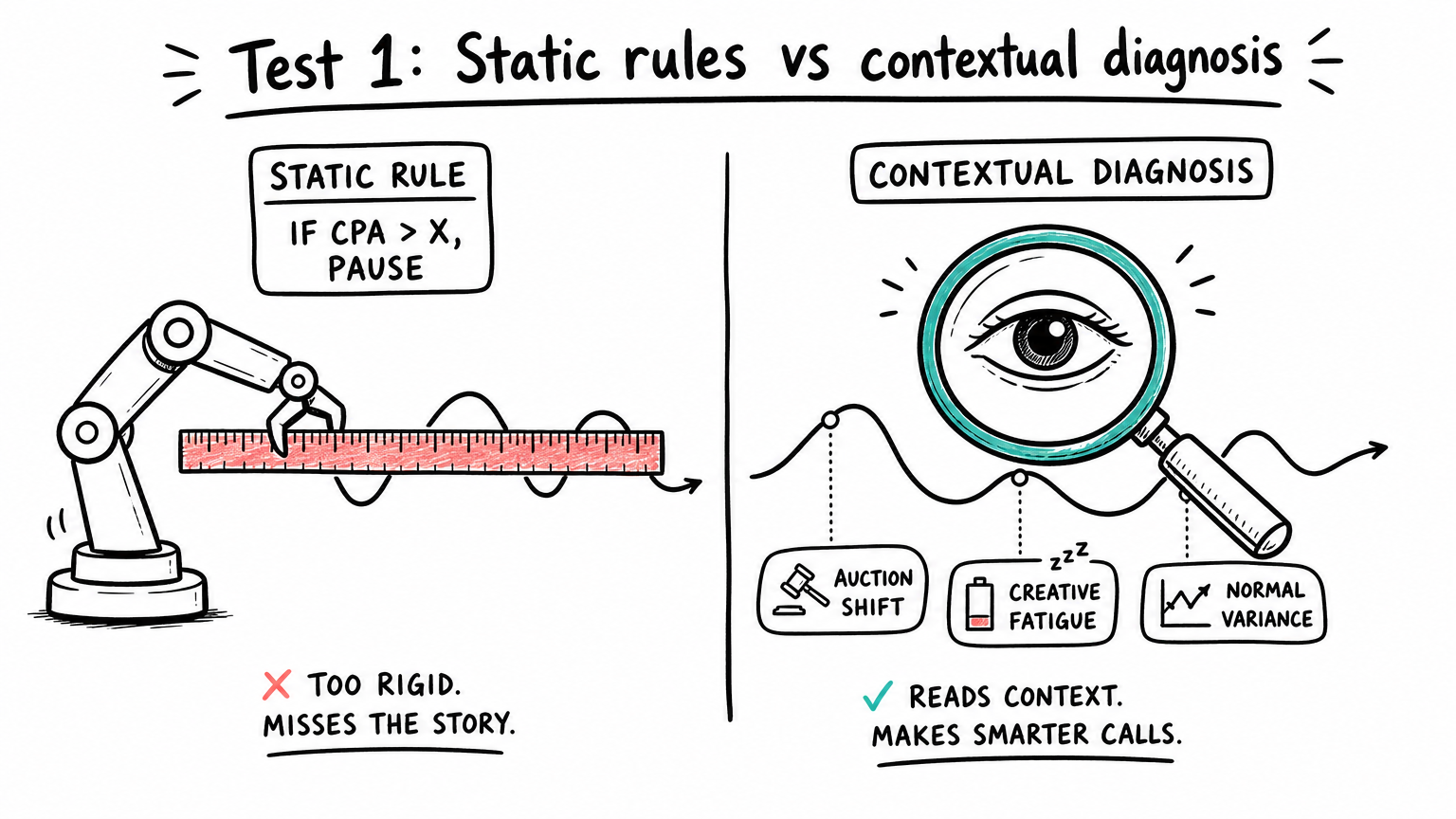
A B2B advertiser once told us their previous tool's rule engine paused their best-performing ad group every Friday afternoon. The reason? CPC naturally fluctuates upward late in the week as weekend inventory shifts. The system read a normal pattern as an anomaly — because it had no context beyond the number.
→ The Question to Ask: "When your system recommends pausing an ad, can it explain what changed in context — audience saturation, competitive pressure, creative fatigue, or platform-level auction shift — and how it ruled out normal variance?"
Why it matters: A tool that can't distinguish between a real problem and natural noise will cost you more than doing nothing.
→ Related: Why "is the data accurate?" is already the wrong question
Test 2 — "Full transparency — you're always in control."
The Claim: You can see what the AI is doing and override it at any time.
The Reality: "Transparency" usually means a dashboard showing what happened. It rarely means you can see why the system recommended an action, or reverse-engineer the logic before it fires.
→ The Question to Ask: "Before the system executes an action, can I see the exact logic chain — trigger condition, contextual factors considered, confidence score — and reject it with one click? Can I also set boundaries the system must never cross, regardless of what the data says?"
Why it matters: Control isn't a read-only dashboard. It's the ability to inspect reasoning, set hard limits, and override — before money moves.
→ Related: Trust isn't built in a day — the agent trust ladder
Test 3 — "AI-powered creative at scale."
The Claim: The platform helps you produce more creative variations, faster.
The Reality: "AI creative" usually means one of two things: (a) generating copy/image variations in a silo, disconnected from performance data; or (b) reporting which existing creatives are fatiguing — without doing anything about it.
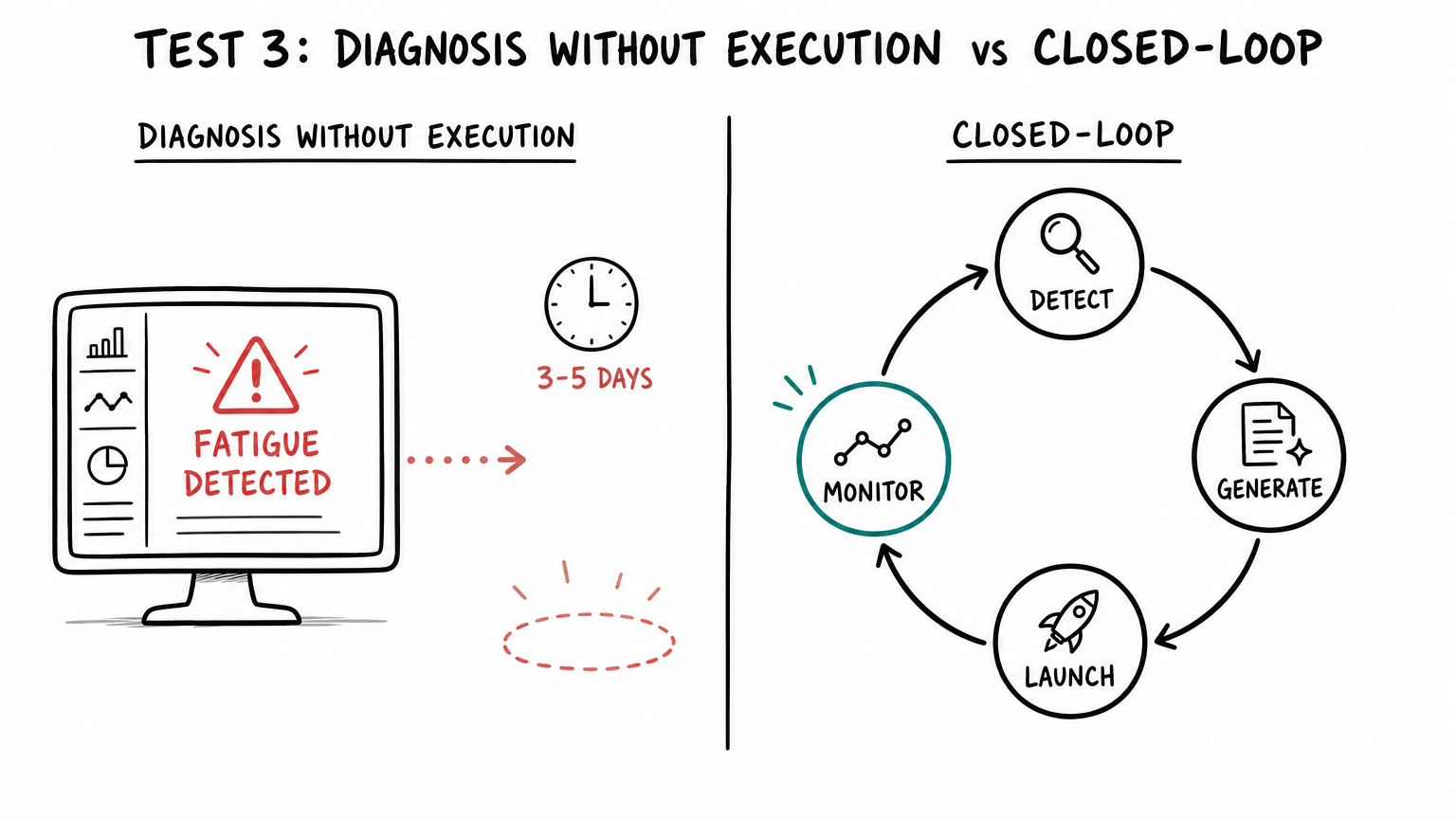
The gap between "your creative is dying" and "a replacement is live and spending" is where budget goes to waste. In our data, that gap averages 3–5 days for teams using diagnosis-only tools.
→ The Question to Ask: "When the system detects a creative is fatiguing, what happens next — automatically? Does it generate a replacement, build the campaign structure, and launch it via API? Or does it hand me a report and wish me luck?"
Why it matters: Creative intelligence without creative execution is just an expensive alert system.
→ Related: The full closed-loop framework from fatigue detection to live replacement
Test 4 — "Works across all major platforms."
The Claim: One place to manage Meta, Google, TikTok, and more.
The Reality: "Cross-platform" often means you can view data from multiple sources in one dashboard. It doesn't mean the system understands how platforms interact, or can execute natively on each one.
→ The Question to Ask: "On each platform you support, can the system natively create campaigns, adjust bids, pause ads, and upload creatives through official APIs — or does it only read data and leave execution to me?"
Why it matters: A read-only aggregator saves you one browser tab. A system with native execution across platforms saves you the operational overhead that actually drains your team's hours.
Test 5 — "The system learns and improves over time."
The Claim: The AI gets smarter the more you use it.
The Reality: Most systems reset every session. They have no persistent memory of what you tested last month, what creative angles have been exhausted, or what operational preferences you've established.
→ The Question to Ask: "If I tested 20 creative angles over the past quarter, does the system remember which ones worked, which audiences saw them, and which are exhausted — without me re-explaining the history?"
Why it matters: Growth is a compounding game. A system without memory starts from zero every conversation. A system with memory compounds institutional knowledge that would otherwise evaporate when people leave.
→ Related: Why memory is the compound-interest lever most teams are missing
The 5-Question AI Ad Tool Test — Summary
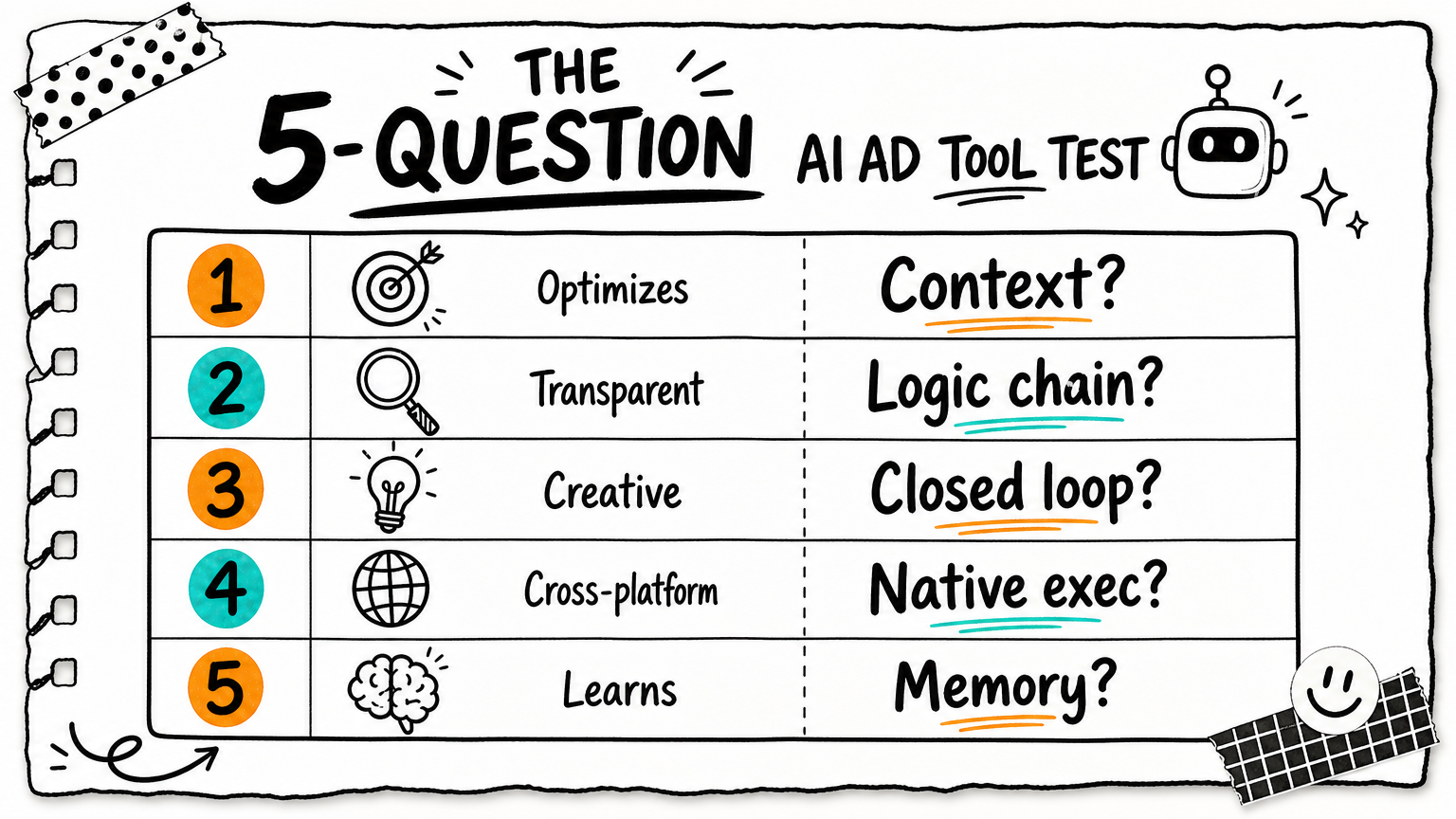
| # | Claim | The Question |
|---|---|---|
| 1 | "Optimizes automatically" | Can it explain why in context, not just what triggered? |
| 2 | "Full transparency & control" | Can I inspect logic, set hard limits, and reject actions before execution? |
| 3 | "AI creative at scale" | Does it close the loop from diagnosis to live replacement — automatically? |
| 4 | "Cross-platform" | Can it execute natively on each platform, or only read? |
| 5 | "Learns over time" | Does it remember what you've done — without being told again? |
How GrowthGPT Answers These Questions (Honestly)
We built GrowthGPT as an AI growth agent — not another AI ad creative tool — but this test applies to any system you'd trust with your ads, us included. Here's where we are — and where we're still pushing:
| Test | GrowthGPT Today | Honest Boundary |
|---|---|---|
| 1 — Contextual diagnosis | Multi-layer analysis: creative fatigue, auction dynamics, audience saturation, cross-platform baselines | Cannot access your backend analytics (GA4, Mixpanel) unless you share data in-session |
| 2 — Trust architecture | Pre-execution preview, one-click reject, hard guardrails, full operation ledger | Automated scheduling requires explicit opt-in per rule |
| 3 — Creative closed loop | Detect fatigue → AI-generate replacement → build campaign → launch via API, single session | Video generation is storyboard + keyframe stage; full rendered video requires external production |
| 4 — Cross-platform execution | Native API execution on Meta, Google, TikTok — create, pause, adjust, upload | Each platform requires separate OAuth; no unified "push one button for all" |
| 5 — Ledger memory | Persistent memory across sessions: tested angles, operational preferences, past decisions | Memory is append-based; no automated "forgetting" of outdated context without user signal |
Use This Test
If you're evaluating AI ad tools, don't trust this article. Take these 5 questions and ask us. Then ask every competitor.
Whoever answers most specifically is worth your time.
Run the 5-Question Test on a real account → Try GrowthGPT free