Detecting Ad Fatigue Is the Easy Part. Fixing It Is What Matters.
Creative fatigue kills ad performance in days. A data-backed framework to detect it across Meta, TikTok and Google — and how GrowthGPT closes the loop from diagnosis to automated execution in one platform.
TL;DR: Creative fatigue is the single most predictable reason winning ads stop working — and it's accelerating. Meta's Andromeda algorithm now burns through creatives in 7 days. TikTok fatigues 4× faster than Meta.
Most tools stop at telling you which ad is dying. GrowthGPT detects fatigue and automatically executes the fix — reallocating budget, pausing burned-out ads, launching fresh creative variations, and running structured experiments. Zero platform switching required.
Your Best Ad Just Flatlined
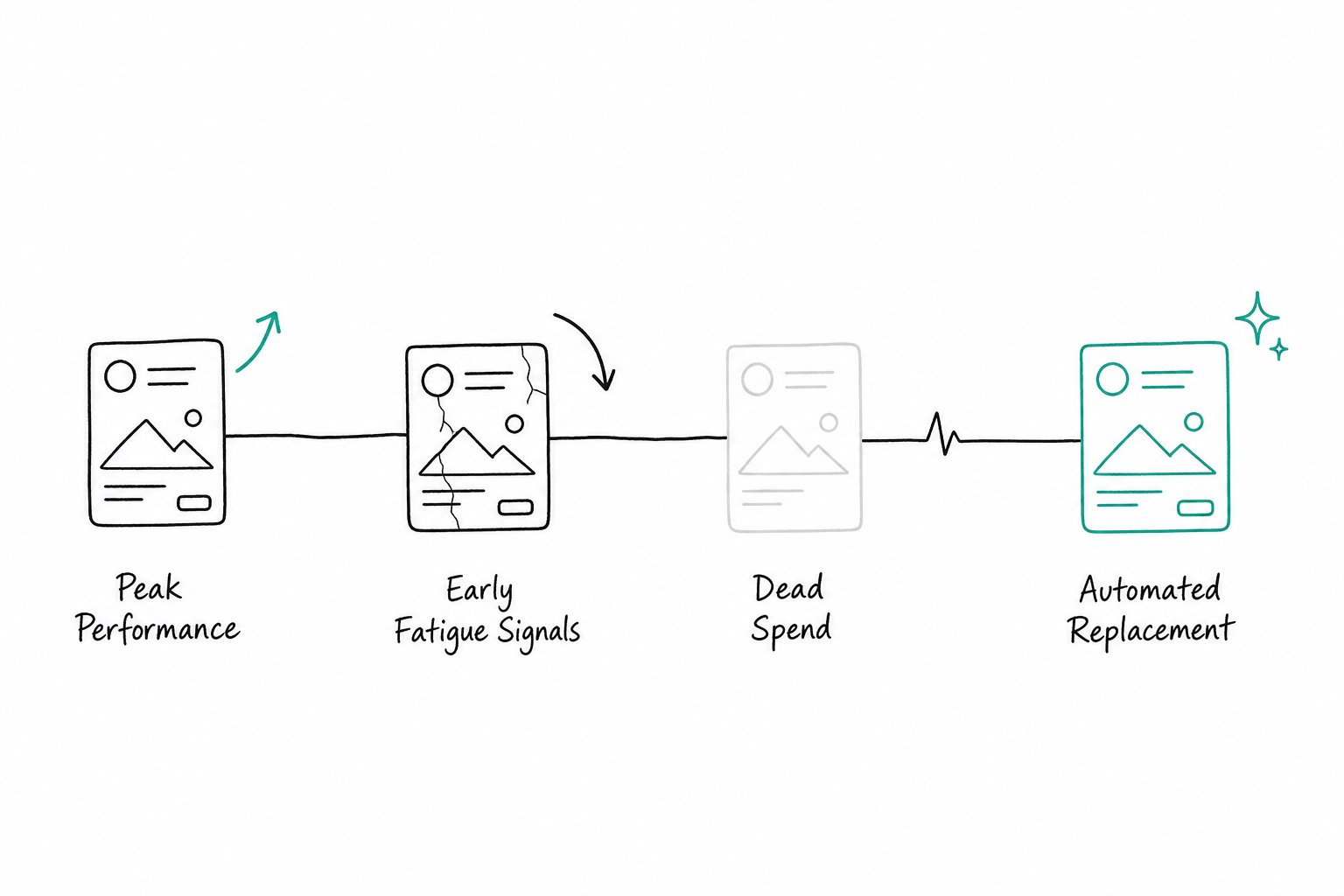
It's Tuesday morning. You open your ad account and your top-performing campaign — the one that generated 40% of last week's revenue — has a CPA that doubled overnight. CTR dropped 34%. Frequency crept past 4.0 while you weren't looking.
You know what happened: creative fatigue. What used to take three weeks now happens in one. The audience saw your hook enough times to develop permanent blindness to it.
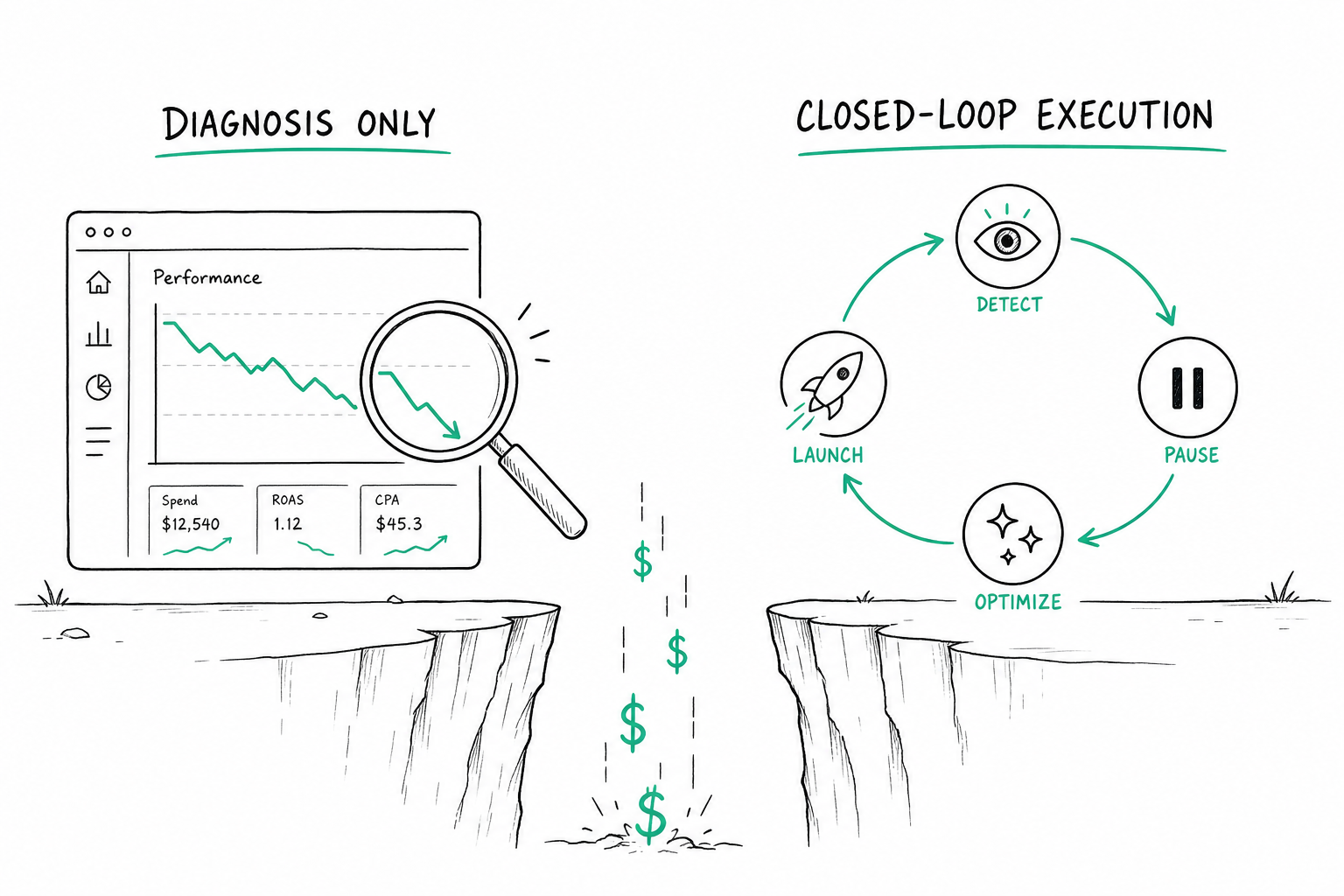
Here's the part nobody talks about: knowing your creative is fatigued doesn't fix anything. You still need to pull the ad, reallocate the budget, produce a new variation, set up a test structure, and monitor the replacement. That chain takes most teams 3–5 days. During those days, you're hemorrhaging spend on a dead creative.
The gap between "diagnosis" and "fix" is exactly where your money goes to die.
The Cost of Doing Nothing: What the Data Says
Creative fatigue compounds daily. Here's the fatigue tax in numbers:
- The Frequency Penalty: First-time viewers are 5.7% more likely to purchase. But viewers who've seen an ad 6–10 times become 4.1% less likely to buy than those who saw it 2–5 times (Simulmedia frequency research).
- The CPC Spike: CPCs increase approximately 12% for every unit of frequency increase once fatigue sets in (Yume.video).
- The 11-Day Cliff: Across managed Meta accounts, the median ad set hits its first fatigue signal at day 11, with frequency at 3.2 and CTR down 38% from launch (Coinis Q1 2026 data).
Platform-Specific Decay Rates:
| Platform | Typical Lifespan | Key Danger Signal | Frequency Red Zone |
|---|---|---|---|
| TikTok | 3–7 days | Hook rate drops 15–20% | > 2.5/week |
| Meta (FB/IG) | 7–14 days | CTR declines 20–30% from baseline | > 3.0 (Prospecting) / > 5.0 (Retargeting) |
| Google Display | 4–6 weeks | CPM spikes 50–100% with flat CTR | > 5–7 impressions/week |
TikTok's high-velocity feed means creative lifespans are roughly 4× shorter than Meta's (TikAdTools 2026). Running the same refresh cadence across both platforms is a guaranteed way to waste budget.
The 5-Step Framework: Detect, Decide, and Execute Before ROAS Crashes
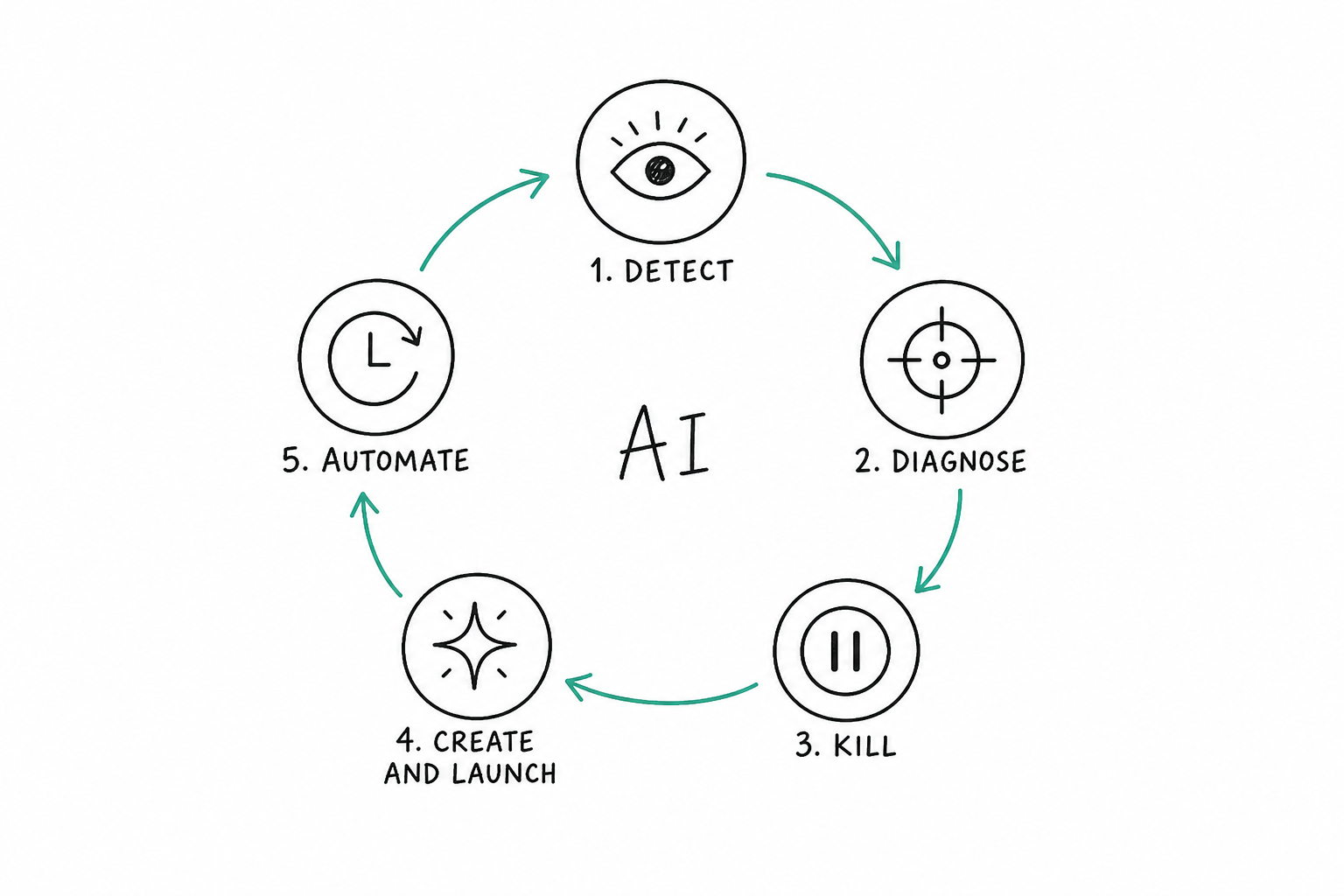
Most frameworks stop at "detect and refresh." That's only half the job. Here's the complete closed loop.
Step 1: Establish Creative-Level Baselines
The Trap: Relying on generic thresholds like "refresh when CTR drops 20%." A warm retargeting ad decays completely differently from a cold prospecting ad.
The Fix: Record peak metrics (CTR, CPC, CVR) in the first 72 hours post-learning phase. Track hook rate (3-sec views ÷ impressions) as the leading indicator — it drops 3–5 days before CTR moves.
How GrowthGPT Automates It: The creative insights engine compares each creative's current metrics against its own launch baseline, outputs fatigue confidence scores, and classifies every creative into Keep / Kill / Scale / Watch tiers — across Meta, TikTok, and Google simultaneously.
Step 2: Diagnose the Element, Not Just the Ad
The Trap: Killing an entire video when only the first 3 seconds are tired, wasting production effort and discarding validated learnings.
The Fix: Hook rate down + hold rate stable = hook fatigue only. CTR down across all formats = messaging angle exhaustion.
How GrowthGPT Automates It: The diagnostic engine decomposes performance by element — creative type, hook retention, hold rate. On TikTok, it evaluates within the Campaign → Ad Set → Creative hierarchy to pinpoint exactly which layer needs refreshing.
Step 3: Kill the Losers and Protect the Budget
The Trap: Taking 1–3 days to manually pause burned-out ads and shift budgets while money bleeds.
The Fix: Cut immediately once confirmed.
How GrowthGPT Automates It: Executes budget and status changes directly via platform APIs. On Meta, it pauses underperformers and reallocates daily budget to healthy ads. On TikTok GMV Max, it removes fatigued videos and boosts fresh winners — pending your one-click approval.
Step 4: Launch the Replacement Without Leaving the Platform
The Trap: Switching to design tools, waiting for assets, re-uploading, and manually rebuilding ad sets. Each handoff adds days.
The Fix: Streamlined, in-platform generation and deployment.
How GrowthGPT Automates It: The built-in AI creative engine generates brand-compliant ad image variations on demand. GrowthGPT then creates new Campaigns end-to-end — audience, budget, bidding, copy, creative upload — across Meta, TikTok, and Google. One conversation, not one week.
Step 5: Schedule, Automate, Repeat
The Trap: Treating fatigue as a one-time fire to put out instead of a permanent cycle.
The Fix: Build a continuous, self-healing rotation cadence.
How GrowthGPT Automates It: Agent Ops lets you set recurring daily jobs — auto-pause at specific times, activate replacements on schedule, monitor new creatives automatically. The full loop: detect → pause → replace → monitor → repeat.
The Closed-Loop Difference: Reporting vs. Fixing
| Workflow Stage | Analytics-Only Tools (e.g., Superads) | GrowthGPT |
|---|---|---|
| Detect fatigue |  Flags declining creatives Flags declining creatives | Flags + confidence scores + element-level diagnosis |
| Decide action |  You figure it out You figure it out | Structured Keep / Kill / Scale per creative |
| Pause the loser | Switch to Ads Manager | Executes pause directly via API |
| Shift budget | Manual adjustment | Programmatic budget reallocation |
| Create new asset | Open Canva / Figma | GrowthGPT AI generates new variations |
| Launch campaign | Manual platform setup | End-to-end campaign creation |
| Automate rotation | Calendar reminders | Recurring scheduled jobs |
Real-World Impact
A DTC ecommerce team spending $45K/month across Meta and TikTok used GrowthGPT during a Q1 refresh cycle. In week one, the system flagged 12 fatigued creatives (average CTR decline: 31%, frequency: 3.8), auto-paused 8, shifted budget to 4 healthy performers, and launched 6 AI-generated replacements the same day.
Result: CPA recovered to within 8% of baseline in 72 hours. Compared to their old 9-day manual cycle (where CPA overshot by 43% before stabilizing), they saved ~$4,200 in wasted spend — just by eliminating the delay between detection and execution.
FAQ
How quickly does creative fatigue set in on TikTok versus Meta?
TikTok creatives fatigue roughly 4× faster. Expect decline within 3–7 days at scale; on Meta post-Andromeda, the window is 7–14 days. The difference is TikTok's high-velocity feed and its audience's demand for constant novelty. Set platform-specific cadences, not one-size-fits-all timelines.
What's the earliest metric that signals fatigue before CPA spikes?
Hook rate (3-sec views ÷ impressions) is the leading indicator, declining 3–5 days before CTR and CPA visibly deteriorate. A 20–30% CTR drop from launch baseline is confirmation. By the time CPA spikes 40%+, you've already burned days of budget.
Can I fix fatigue by just changing the thumbnail or CTA text?
No. Meta's Andromeda groups visually similar creatives under the same Entity ID via a Similarity Score. Cosmetic swaps don't register as new creative. You need concept-level changes: fresh hooks, different visual styles, or new messaging angles.
How is GrowthGPT different from Superads or Motion?
Analytics tools show you which creative is declining — valuable but incomplete. GrowthGPT provides the same diagnostic depth plus direct execution: auto-pause, budget reallocation, AI creative generation, end-to-end campaign creation, and automated rotation scheduling. One platform handles the entire chain from "this ad is dying" to "replacement is live."
Stop paying for a tool that only reports the problem. GrowthGPT sees it and fixes it — one closed loop, start to finish.