The Gap Nobody Talks About: From AI Copywriting to Agentic Growth
Most teams have AI write ad copy. Almost none have an agent actually run their growth loop. The difference isn't intelligence — it's plumbing.
Most teams have figured out how to get AI to spit out ad copy. Almost none have figured out how to let an AI agent actually run their growth loop.
The difference isn't intelligence. It's plumbing.
One-Shot vs. Closed-Loop
Here's the uncomfortable truth: asking ChatGPT to write your Facebook ad and letting an agent manage your growth engine are not two points on the same spectrum. They're fundamentally different architectures.
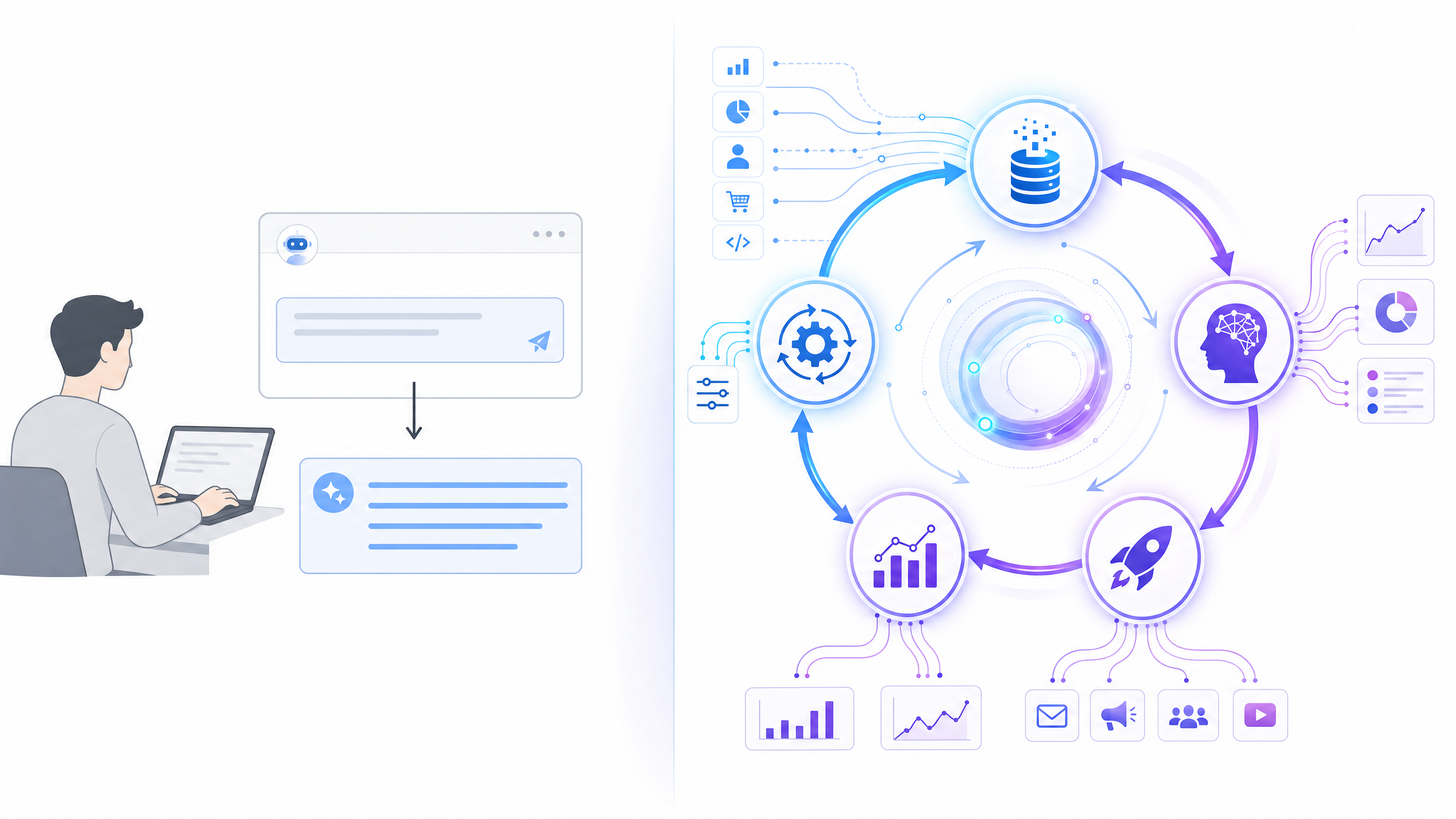
Figure 1 — Left: the linear path of AI copywriting (prompt in, text out, no feedback). Right: an agent-driven growth loop where data, decisions, execution, and measurement flow continuously.
- Input — An AI Copywriter uses a static prompt. A Growth Agent uses live data + objectives.
- Output — An AI Copywriter outputs text. A Growth Agent outputs decisions, actions, and measurement.
- Feedback — An AI Copywriter relies on human intuition ("Looks good!"). A Growth Agent relies on automated CPA/ROAS feeds.
- Iteration — An AI Copywriter makes you rewrite the prompt. A Growth Agent self-corrects.
Copy generation is a single function call. Growth is a continuous loop: plan → execute → measure → optimize → repeat. What's missing isn't a smarter foundation model — it's the wiring that connects the model to reality.
The 5 Layers Separating a Chatbot from a Growth Engine
To move from a glorified copywriter to true agentic growth, a system needs five foundational layers:
1. Access Live Data
Without live account data — spend, conversions, creative decay curves — your agent is just a copywriter with extra steps.
2. Apply Business Judgment
"CPA is up 30%" is an observation. "Pause the ad" is a conclusion. Between them sits context: is it creative fatigue, auction pressure, or seasonality? That judgment can't live in a single prompt.
3. Execute Decisions
Knowing what to do is useless if the agent can't pull the levers — adjusting bids, pausing losers, launching tests, and reallocating budget.
4. Enforce Guardrails
An agent that can act but has no boundaries is a liability. Budget caps, compliance rules, and brand-safety floors aren't optional; they are table stakes.
5. Retain Memory
Growth compounds. If the agent forgets what was tested last week, it can't build on what worked. Memory turns isolated actions into a learning system.
Where Teams Actually Get Stuck
We see two bottlenecks over and over:
- Connection — Models are capable enough. They just aren't wired directly into ad platforms, analytics, or execution APIs.
- Trust — Nobody wants to hand the wheel to a black-box system with no transparency and no brakes.
This is why 90% of "AI marketing tools" on the market are still just text generators. Humans copy-paste. Humans judge. Humans execute. The AI is a faster typewriter.
How to Cross the Gap (Without Blowing Things Up)
Don't aim for full autonomy on day one. Earn it in stages:
- Stage 1: Observe — Connect the data. Let the agent auto-generate diagnostics.
- Stage 2: Recommend — Surface data-backed suggestions. A human approves before any action is taken.
- Stage 3: Execute (Low-Risk) — Auto-pause clearly unprofitable ads. Auto-adjust budgets within a strict, pre-defined band.
- Stage 4: Run (Autonomous) — High-frequency decisions loop autonomously. Humans govern overall strategy and manage exceptions.
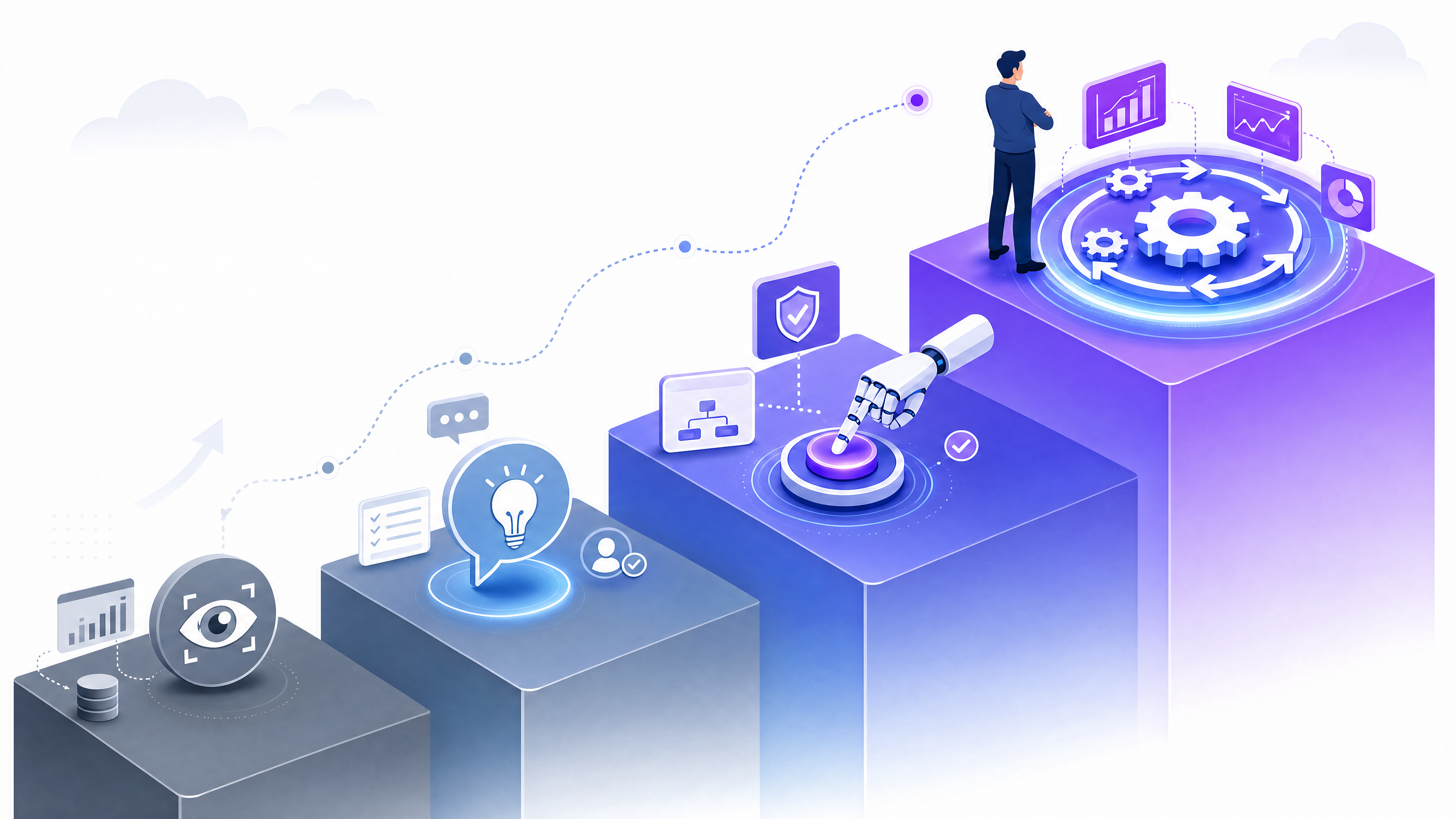
Figure 2 — The trust ladder: from passive observation to full autonomous operation, with human oversight scaling inversely as the system proves reliability.
The Bottom Line
What separates "AI writes my ads" from "an agentic system runs my growth" isn't a better prompt or a shiny new LLM. It's robust data pipelines, execution permissions, judgment frameworks, and — most importantly — earned trust.
Copy generation is maybe 1% of what a true growth system does. The other 99% is wiring that capability into a loop that reliably produces business outcomes.
This is why we built GrowthGPT.
We got tired of faster typewriters. We built the plumbing, the guardrails, and the memory required to turn AI into a closed-loop, agentic growth engine.
Stop prompting. Start looping.