Skills: Bring Your Team's Proven Methods Into Every Growth Loop
Most experienced growth teams already have a clear way of working, but those methods live in senior operators' heads, scattered docs, and old chat threads. Skills turn a proven method into a reusable, maintainable, reviewable work unit that runs in every cycle.
In the previous article, we introduced Context.
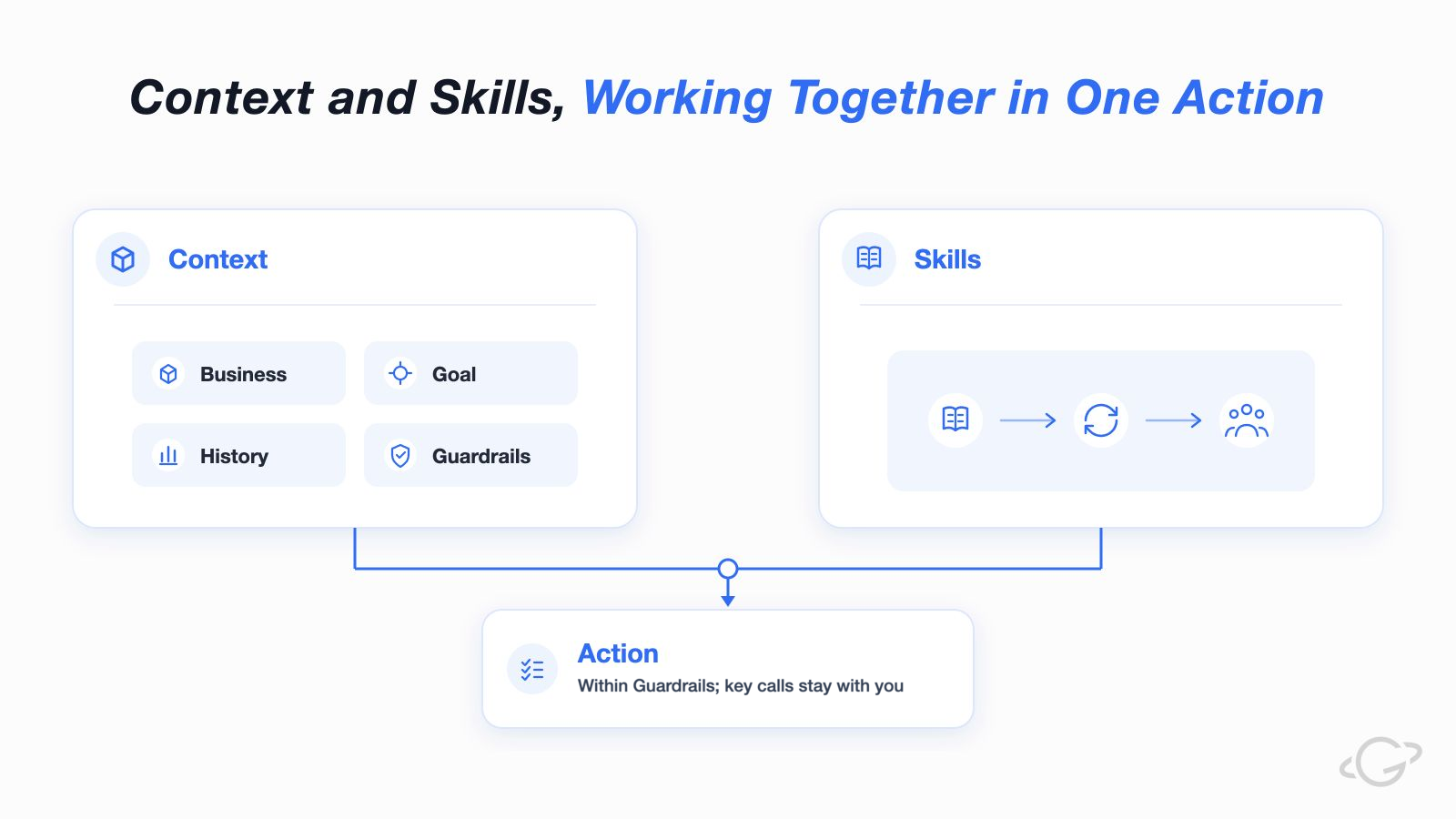
Context helps GrowthGPT understand the business behind a decision: what the team is working toward, what has happened before, and which decisions still require human confirmation.
But understanding the business is only part of the work.
The system also needs to know how your team wants a recurring category of work to be done.
That is what Skills are for.
Context tells the system what matters. Skills tell it how to act.
Most experienced growth teams already have a clear way of working.
They know how to investigate performance changes, which signals to check first, and how to distinguish a creative issue from a targeting, budget, or platform issue. They know how to review brand content and how to turn a campaign test into a better plan for the next round.
But these methods often live in senior operators' heads, scattered documents, chat threads, or old retrospectives.
As a result:
- New teammates need repeated onboarding.
- Similar work is handled differently by different people.
- Teams keep re-explaining the same standards.
- Valuable expertise becomes difficult to maintain as the business changes.
The problem is not that teams lack experience. It is that their experience has not yet become a reusable team capability.
A Skill Is More Than a Longer Prompt
Many teams already use prompts to standardize parts of their work. That is a useful starting point.
A clear prompt can help someone complete a one-time analysis, retrospective, or content review more quickly.
But when a team wants to reuse, maintain, and improve a method across every cycle of work, a prompt is often not enough.
A prompt says:
Handle this task this way.
A Skill says:
Whenever this kind of work appears, this is how our team operates.
The difference is not the length of the instruction. It is whether the method can be reused, maintained, reviewed, and improved over time.
What a Skill Needs to Define
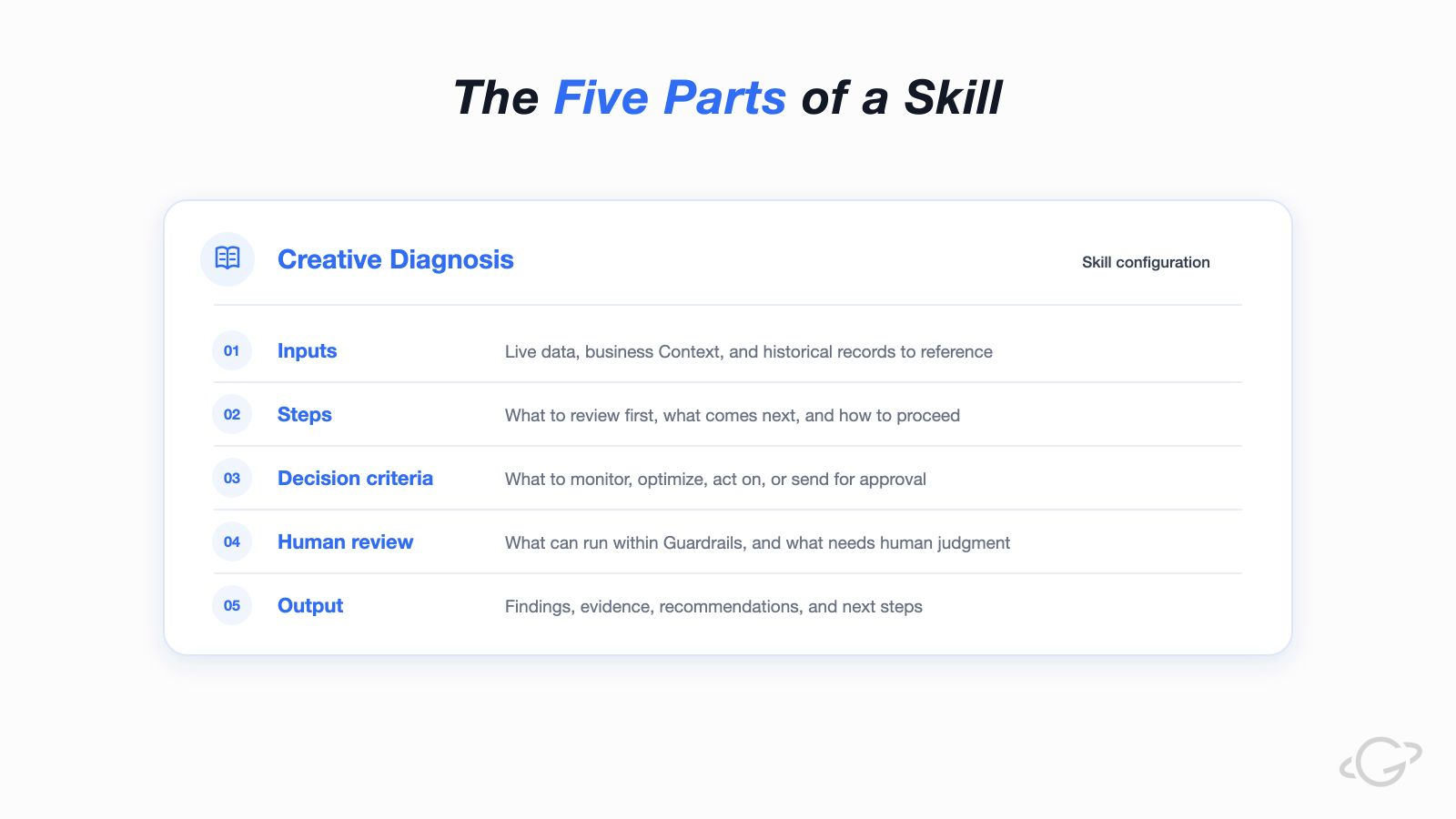
A complete Skill clarifies five things:
- Inputs — What live data, business Context, and historical records should inform the task?
- Steps — What should be reviewed first? What happens under different conditions?
- Decision criteria — Which situations should remain under observation, which need optimization, and which should move into an action or approval flow?
- Human review — What can move forward within Guardrails, and what requires human judgment?
- Output — What should the result include: findings, evidence, recommendations, next steps, and unresolved decisions?
A Skill is not just a way to ask AI for an answer.
It helps the team complete a category of work consistently—and carries each result into the next cycle.
Three Skills Worth Starting With
You do not need to configure every workflow at once.
The best place to start is usually a high-frequency workflow your team already handles well.
Brand Content Review
Capture brand voice, prohibited claims, compliance requirements, visual standards, and approval rules.
The result can show what meets the standard, what needs revision, why it needs revision, and what still requires human review.
Ad Performance Diagnosis
Document the team's investigation sequence for performance changes.
Define which signals matter, how to distinguish likely causes, when to continue observing, and when to escalate.
Creative Retrospective
Standardize how the team reviews creative direction, format, audience, and performance signals.
Each cycle should clarify what to continue, what to stop, and what to test next.
Skills Improve Through Real Work
Skills are not static documentation.
Each execution cycle can reveal where a rule needs refinement, a criterion needs more nuance, or an output could be more useful.
But the system should not change the team's method on its own.
Teams review the evidence, confirm what has changed, and then update the relevant Skill. That is how individual experience becomes durable team capability.
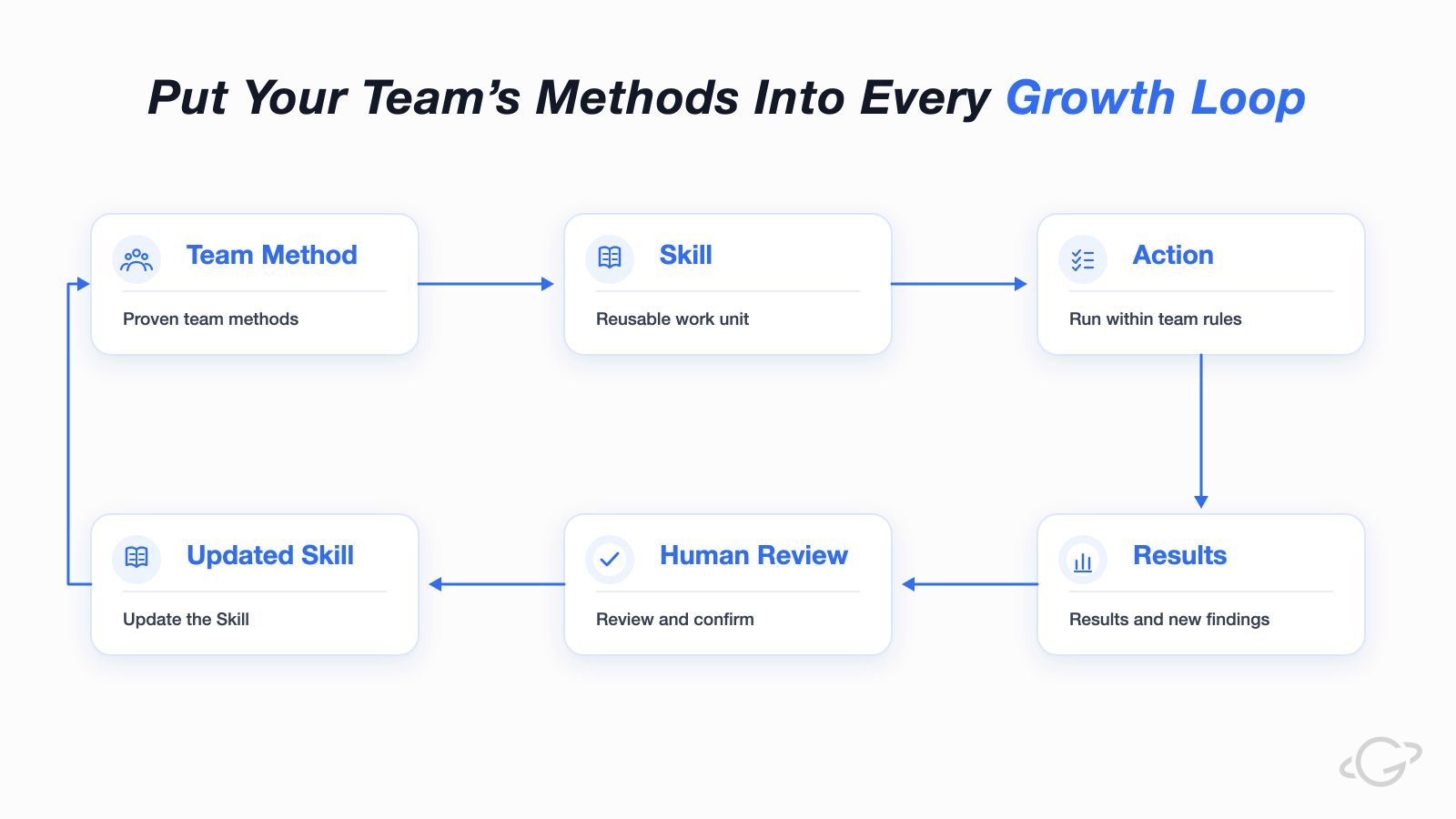
Context gives each Growth Loop the business understanding it needs. Skills give it the team's proven method. Together, they carry better methods into every cycle.
Next, we will look at Scheduled Monitoring: once goals, methods, and rules are clear, how can recurring work continue running inside the Growth Loop?
GrowthGPT 2.0 is now available.
Start with one high-frequency workflow your team already does well—and turn it into your first Skill.
→ Related: GrowthGPT 2.0: A Continuous Growth System