When Foundation Models Eat Ad Tech: What Survives
The first AI ad startup publicly admitted a foundation model killed its product. Here's the structural pattern behind it, why some execution-layer companies survive, and the three assets no model can replicate.
TL;DR
The first AI ad startup just admitted something nobody in this category wants to say out loud: a foundation model made its product obsolete overnight. This post identifies the structural pattern behind the collapse, explains why credential-and-data-heavy players like Madgicx survive, and proposes the three structural assets that separate durable execution-layer companies from wrappers waiting to be absorbed.
The First Admission
The first AI ad startup just admitted something almost nobody wants to say out loud:
Foundation models are starting to erase entire software categories.
In February 2026, Ira Bodnar, founder of San Francisco-based Ryze AI, posted five words that ricocheted across ad-tech Twitter: "Claude just killed our startup."
Her company built a tool for managing Google and Meta ads. Within weeks of Anthropic's capability update — and Meta's acquisition of autonomous-agent company Manus AI, which began integrating directly into Ads Manager — Ryze's close rate collapsed from 70% to 20%. The niche Ryze occupied had become a native feature of the models themselves.
Bodnar pivoted to white-label AI workflows for large agencies. The SaaS product that had gained several hundred paying clients in two months was shelved.
Most startups in this position quietly rebrand. Bodnar named the problem out loud. That candor makes the event worth studying — not as a post-mortem on one company, but as a stress test on an entire product category.
Why Wrappers Can't Outrun Models
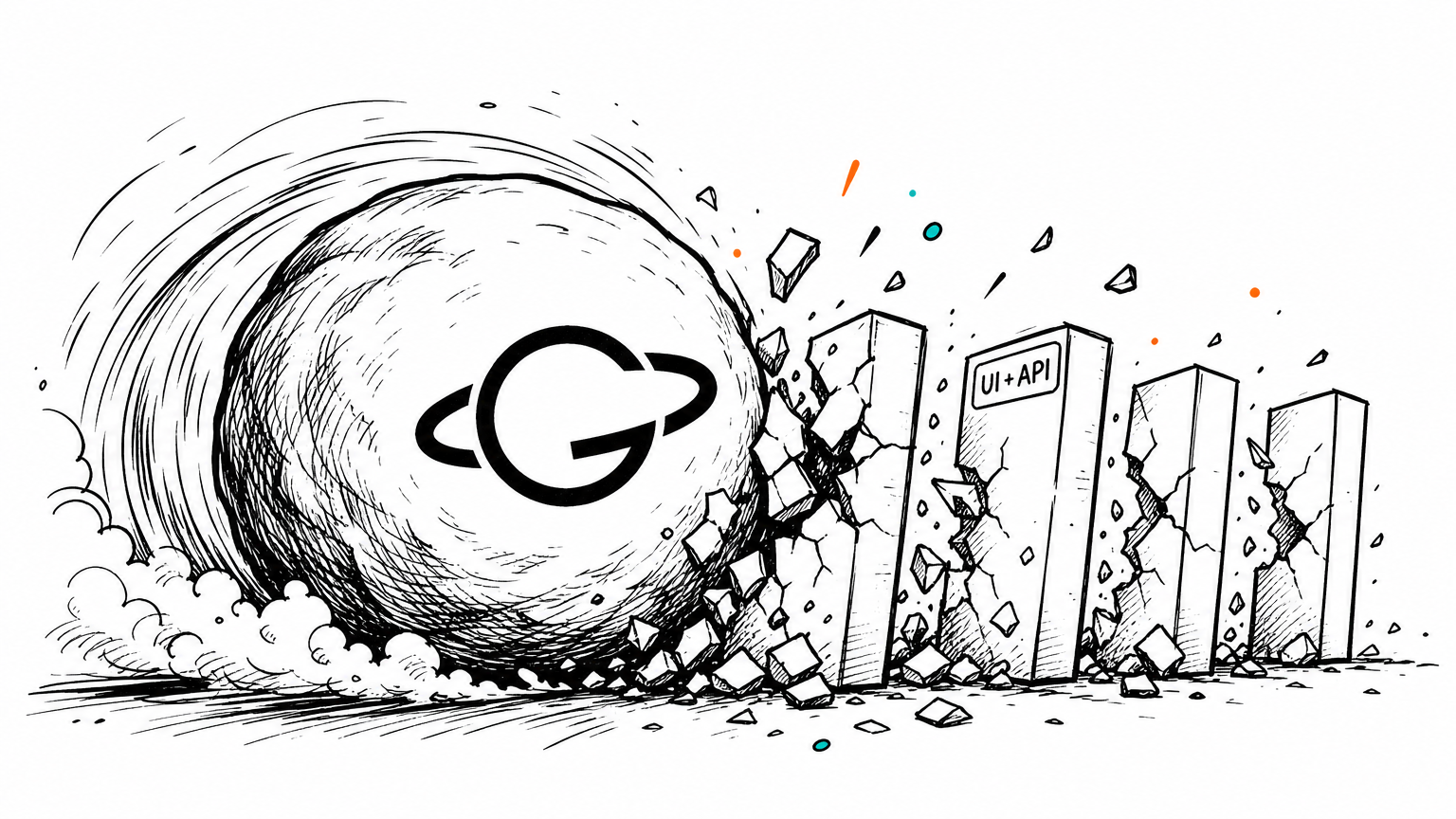
Ryze didn't lose to a competitor. It lost to a positioning problem:
If your product is "foundation model + platform API + UI," every model upgrade erodes your differentiation.
This isn't about effort or talent. It's about where value lives in the stack.
When Claude, GPT, or Gemini natively analyze ad performance, generate creative variations, and draft optimization plans — and when Meta embeds autonomous agents into its own Ads Manager — the "analyze-and-recommend" layer that defined dozens of AI ad startups in 2024–2025 becomes table stakes.
An approval workflow isn't a moat. A prompt library isn't a moat. A dashboard isn't a moat. These are features any model provider can replicate in one product cycle.
The question isn't whether thin wrappers survive. We think most won't. The question is what does survive — and why.
Why Madgicx Isn't a Wrapper
Madgicx survives for the same reason Stripe survived payment APIs and Cloudflare survived CDNs: it owns assets the models don't.
Sanctioned credentials. Meta-certified Business Partner. Legitimate, partner-tier API access that no browser-based agent can replicate without risking account bans.
Proprietary signal corpus. $10B+ in visible annual ad spend across 200,000+ advertisers. No foundation model has access to that data — regardless of how capable it becomes.
Distribution. Two hundred thousand active advertisers produce network effects in benchmarking and pattern recognition that a standalone model can't bootstrap.
Compliant write access. In March 2026, Madgicx launched an MCP server — 49 tools, 22 read, 27 write — providing a sanctioned bridge between AI assistants and live Meta accounts. Meta's 2026 enforcement explicitly targets unauthorized browser automation. Madgicx's MCP is the compliant alternative.
Important caveat: Madgicx's AI Marketer still operates on "daily recommendations + human clicks Launch." Execution is 100% limited to Meta. Its moat is structural — credentials, data, distribution, compliant write — not the AI itself.
Model capabilities inflate. Structural assets don't.
Three Assets Foundation Models Can't Eat
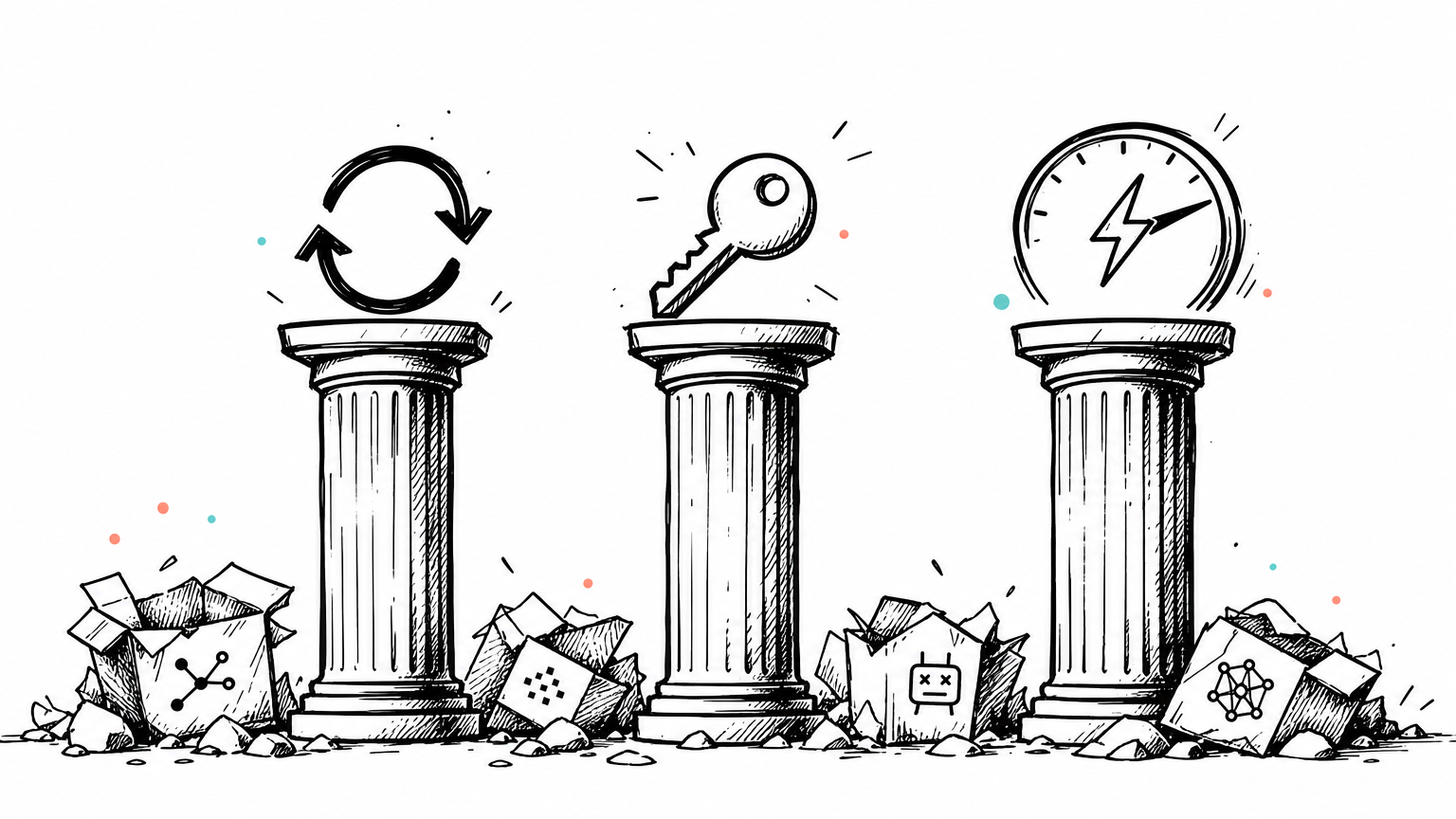
From the Ryze collapse and the Madgicx counter-example, a category-level survival standard emerges. An execution-layer product survives if — and only if — it accumulates assets that become more valuable as models improve:
① Proprietary Feedback Loop
Your execution results feed back into your next decision. The model might be public, but the performance data — what worked, what failed, under what conditions — is yours alone. External models can't access it. The loop compounds: more executions → better signal → better decisions → more executions.
→ Related: Why agents that remember outperform agents that don't
② Execution-Permission Depth
Official, compliant, batch-capable write access to ad platforms. Not browser simulation. Not screen scraping. Not "paste this into Ads Manager." Partner-tier API credentials that let the system adjust bids, shift budgets, pause underperformers, and launch experiments at machine speed — without tripping platform security.
③ Closed-Loop Speed
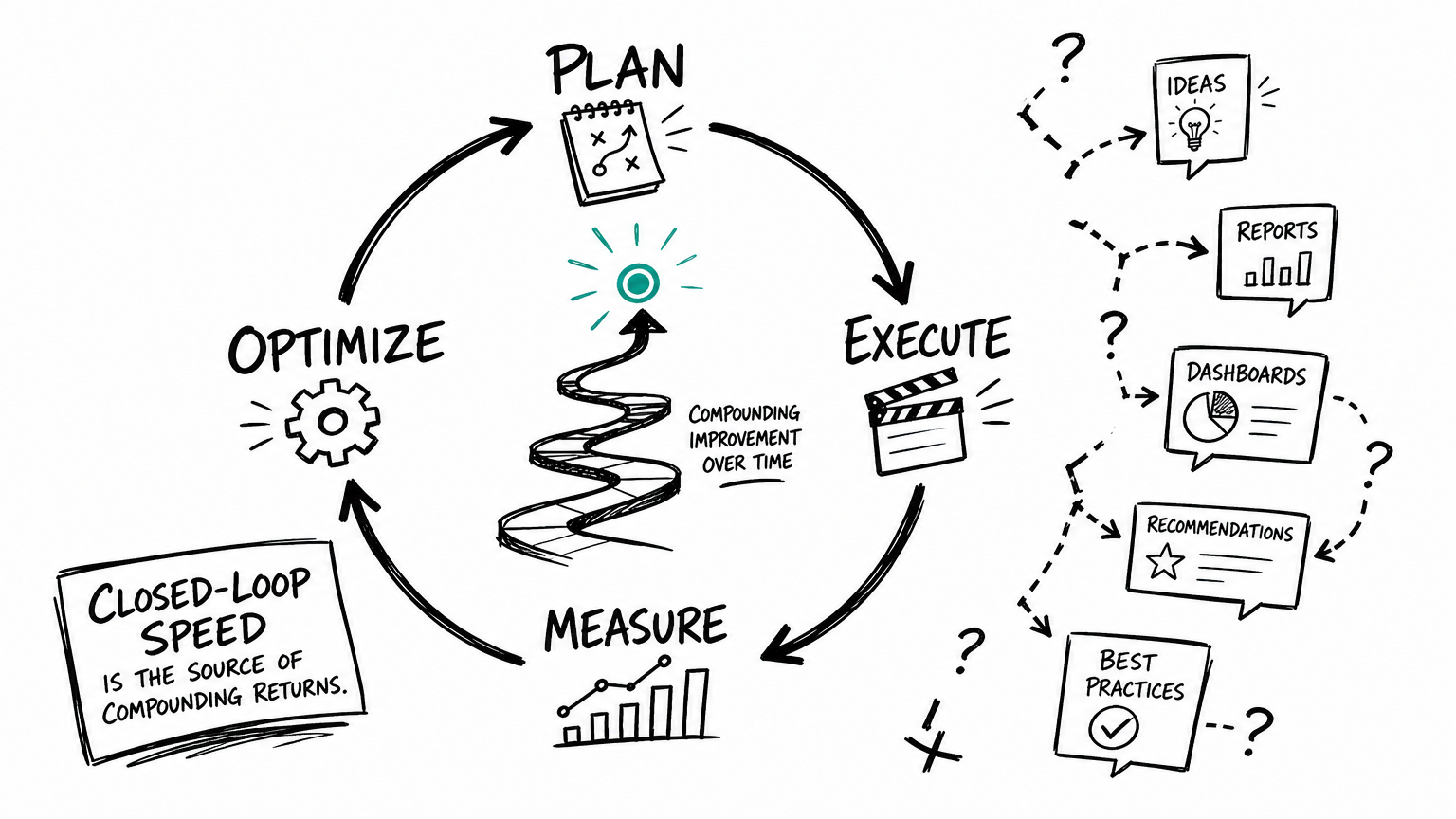
Plan → execute → measure → optimize, end to end, as a productized cycle. Not "we analyze, you implement." The speed of this loop is the source of compounding returns. A system that closes in minutes outperforms one that closes in days — same math as daily compounding vs. annual.
→ Related: The next category doesn't advise — it executes
The execution layer isn't disappearing. It's splitting in two.
Thin execution dies — wrappers that add no proprietary value between model and platform. Thick execution survives — systems with proprietary data, sanctioned permissions, and closed-loop speed.
Why This Is an Entry Window
The shakeout is exactly why this is the best time to enter — if you're building on all three.
Foundation models just did three things for the market:
- Validated demand. The world now knows AI can do advertising, not just analyze it. That education used to cost startups years of evangelism.
- Cleared noise. The "we connected GPT to your ad account" pitch is dying in real time.
- Published the rubric. Buyers can evaluate. The criteria for survival are visible, and they favor builders with structural depth.
Why We Built GrowthGPT This Way
We didn't arrive at these conclusions after building GrowthGPT.
We built GrowthGPT because we arrived at these conclusions.
The reader who's followed the argument this far is already asking: "If Claude can analyze ads today and might operate accounts next quarter, why would I use GrowthGPT?"
Fair question. Same three criteria.
① A system that gets smarter about your business over time
Every conversation compounds. Your brand guidelines, past decisions, performance baselines, and optimization preferences persist across sessions. When a budget adjustment works — or doesn't — that result feeds back into the next recommendation.
A general-purpose AI resets after each chat. We don't. The system benchmarks every suggestion against your historical cost-per-result — not an industry average from a blog post.
Think of it as institutional memory for ad operations — except it never takes PTO and never forgets a lesson learned.
② Not just advice — execution, across three platforms
GrowthGPT holds live, authorized connections to Meta, Google, and TikTok with real write access: pause, activate, adjust budgets, shift bids, change bid strategies, modify schedules, upload creatives, boost winners, remove fatigued assets.
Every write action passes through a confirmation layer and semantic validation.
Why this isn't "just asking Claude to call an API":
- Persistent server-side auth. No re-pasting tokens each session.
- A scheduler that executes at 2 AM Sunday without you being online.
- Business-logic guardrails baked in. A raw LLM has zero awareness of platform policies or your safety thresholds.
We built the infrastructure so the intelligence has somewhere to land.
③ From insight to action in one sitting
Most tools help you see problems. We close the loop inside a single session:
- Pull data → filter underperformers → validate against your rules → propose changes → you confirm → execute → log. Minutes, not days.
- Set conditions once ("if CPA exceeds $30, pause"), and the system patrols hourly.
- After an adjustment fires, re-check results — confirm improvement or revise.
- Diagnose a fatigued creative → generate a new concept → produce the asset → push it live. Same conversation.
The bottleneck in ad operations was never knowing what to do. It's the lag between insight and action. We compress that lag to near-zero.
Platforms: Meta Ads (all objectives) · Google Ads (PMax, Search, App) · TikTok Ads (GMV Max Product & Live, Auction) · TikTok Shop commerce intelligence.
Not just diagnostics — verdicts: For each platform, the system delivers creative-level calls: Keep, Kill, or Scale — with reasoning. When the verdict is "kill," it executes right there.
Built for: Cross-border e-commerce teams (DTC & TikTok Shop sellers) · App-growth teams going global · Agencies scaling output without scaling headcount.
The Knife vs. The Kitchen

ChatGPT, Claude, Gemini — brilliant knives. But a knife doesn't know where your ingredients are, can't turn on the stove, and forgets everything when you leave the room.
GrowthGPT is the kitchen: authorized access to your accounts, a scheduler that works while you sleep, memory that compounds over time, and guardrails that prevent expensive mistakes.
You don't need a smarter knife. You need a kitchen that runs.
FAQ
Will Claude replace AI ad tools?
Thin wrappers — progressively, yes. Tools built on proprietary feedback loops, official platform credentials, and productized closed loops — no. The model is an ingredient, not the product.
What actually counts as "agentic"?
One honest test: can the system complete a full plan → execute → measure → optimize cycle without a human pasting instructions into a platform UI? If yes, agentic. If it generates recommendations and waits for you to click "Launch," it's an advisor with good branding.
How do I know if my current vendor survives?
Three-asset test: (1) Does it accumulate proprietary data that improves decisions over time? (2) Does it have official, compliant write access to your platforms? (3) Does it close the loop autonomously? If all three are "no," you're renting a wrapper.
Closing
Models get smarter. Systems get stronger.
One is rented. The other is owned.
The question was never whether AI can act on advertising. Ryze proved the market wants it. Manus inside Meta Ads Manager proves the platforms are building it. Claude's trajectory proves the models are approaching it.
The real question is: after the AI acts, who owns what it learned — and does the next action get smarter because of the last one?
Intelligence doesn't compound.
Systems do.