Growth Tools Just Entered the Execution Era — Advice Alone Doesn't Cut It Anymore
a16z led a $28M round into Hilbert, validating a new category — the AI growth agent that doesn't just analyze ads but directly runs them. GrowthGPT is one, anchored in execution — adjusting budgets, pausing underperformers, and launching creatives across Meta, Google, and TikTok — all with human approval before anything fires.
TL;DR
For the past decade, growth tools got better and better at seeing data and giving recommendations. But the real bottleneck was never "not knowing what to do." It was "nobody doing it."
A new category is forming: AI that doesn't just report or recommend — it goes into your ad accounts and acts. Adjusts budgets. Pauses waste. Launches new creatives.
ROI happens at the moment of execution, not at the moment of advice.
News Anchor: a16z Just Stamped This Category
In April 2024, a16z led a $28M Series A into Hilbert Health (Axios). Hilbert doesn't build another dashboard — it reaches into healthcare ad accounts and makes changes directly.
That money didn't validate one company. It validated a thesis: the top of the growth-tool value chain just shifted from "telling you what to do" to "doing it for you."
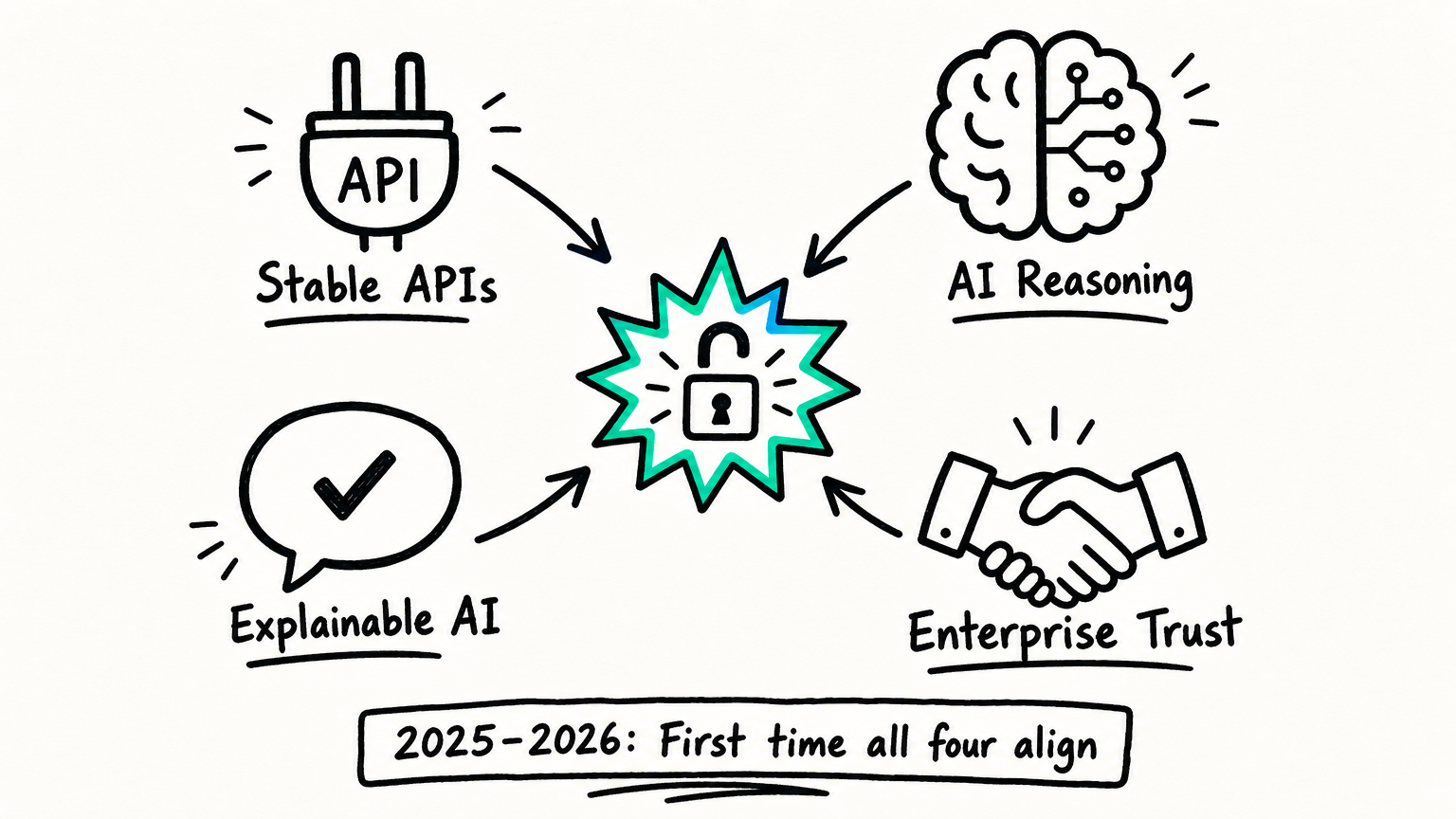
Why Now: Four Conditions Converged
The idea of AI executing inside ad accounts isn't new. What's new is that four prerequisites finally arrived at the same time:
| Condition | Plain English |
|---|---|
| Platform APIs opened up | Meta, Google, and TikTok APIs can now change budgets, create ads, and upload creatives — not just pull reports |
| LLMs understand business context | AI can read "CPA spiked because the creative fatigued," not just "a number went up" |
| Enterprises stopped fearing AI in their accounts | Three years ago, "let a bot change my budget" got you fired. Now the CEO asks why you haven't deployed one |
| Capital stamped the category | a16z backing Hilbert = top-tier VC publicly betting on execution AI. More money will follow |
One line: Growth doesn't compound when you know more. It compounds when you act faster.
The Three-Layer Framework: What a Complete Growth Loop Actually Looks Like
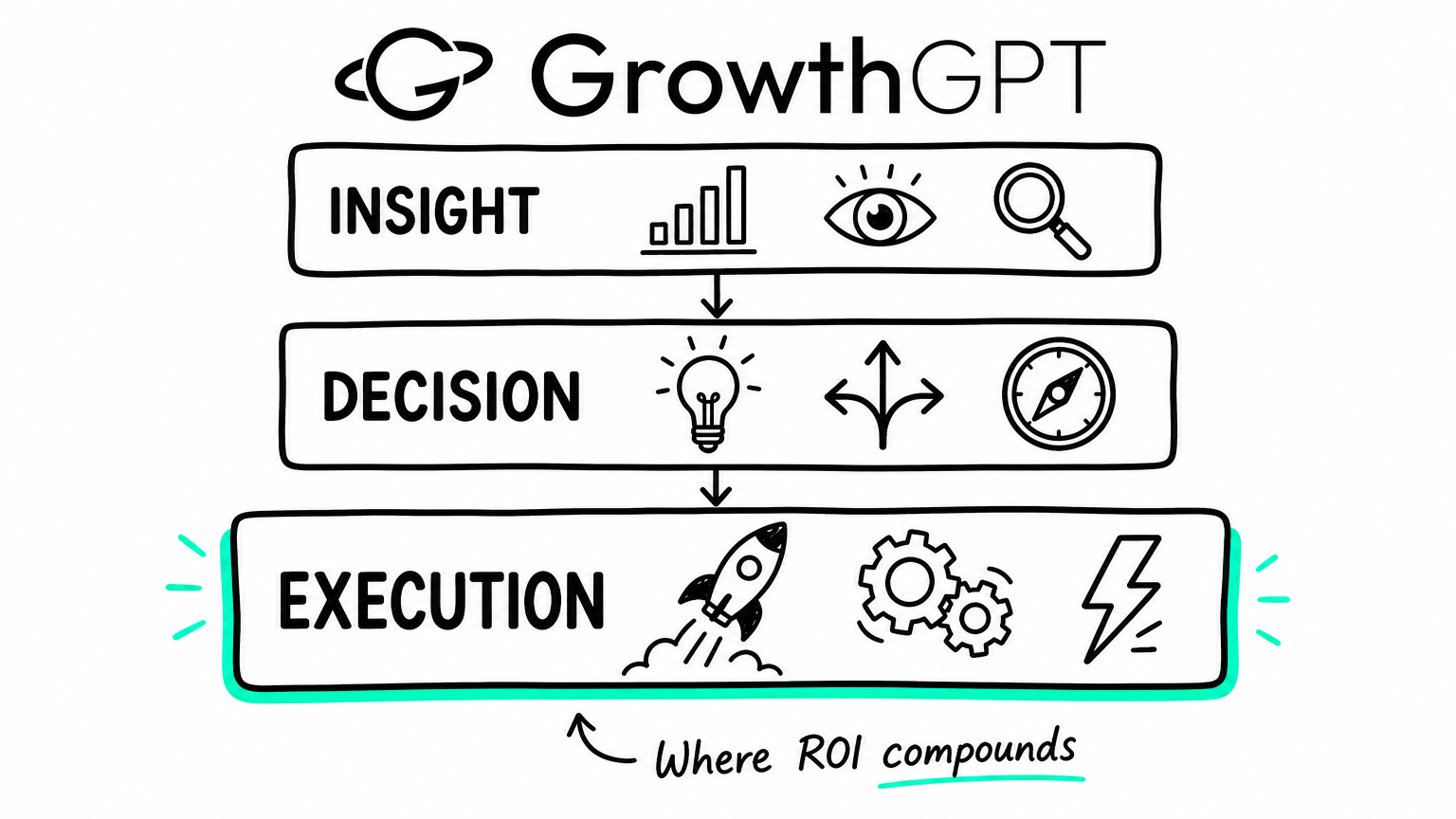
We sort every growth tool on the market by how close it sits to the money:
Layer 1: Insight Layer
What it does: Sees data, finds patterns, tells you what happened.
GA4, Mixpanel, Amplitude, native platform reporting — all live here.
Limitation: No matter how clearly it sees, it won't act for you.
Layer 2: Decision Layer
What it does: Turns data into recommendations — increase budget here, pause that, swap this creative.
Many AI tools stop at this layer. They're a smarter advisor. Still just an advisor.
Limitation: Recommendations that pile up unexecuted are worth zero.
Layer 3: Execution Layer
What it does: Goes into your accounts and acts — changes budgets, pauses Ad Sets, uploads creatives, builds new ads.
This is the last mile the growth loop has been missing.
Insight creates awareness. Decision creates intent. Execution creates outcomes.
GrowthGPT is anchored in execution (Layer 3) — and now runs the full loop across strategy, creative, launch, and analytics. Not because insight and decisions don't matter — but because the market already has plenty of tools for those. What's missing is the one that actually does the work.
ROI Happens at the Moment of Execution
Simple math:
Your AI tool surfaces 5 optimization recommendations every morning. Your media buyer sees them at 9 AM, gets pulled into meetings, remembers to act on 2 of them by evening. The other 3 expire — budget ran 8 extra hours on a dead Ad Set, creative fatigue burned another full day of spend.
Recommendations don't generate returns. Executed recommendations generate returns.
The speed gap compounds exponentially:
- Killing waste 4 hours faster every day → tens of thousands saved per month
- Swapping fatigued creatives same-day → CPM doesn't spiral
- Scaling a winner within 2 hours of breakout → you catch the platform's traffic window
Growth doesn't compound when you know more. It compounds when you act faster.
Execution in Action: Three Scenarios in a Single Day
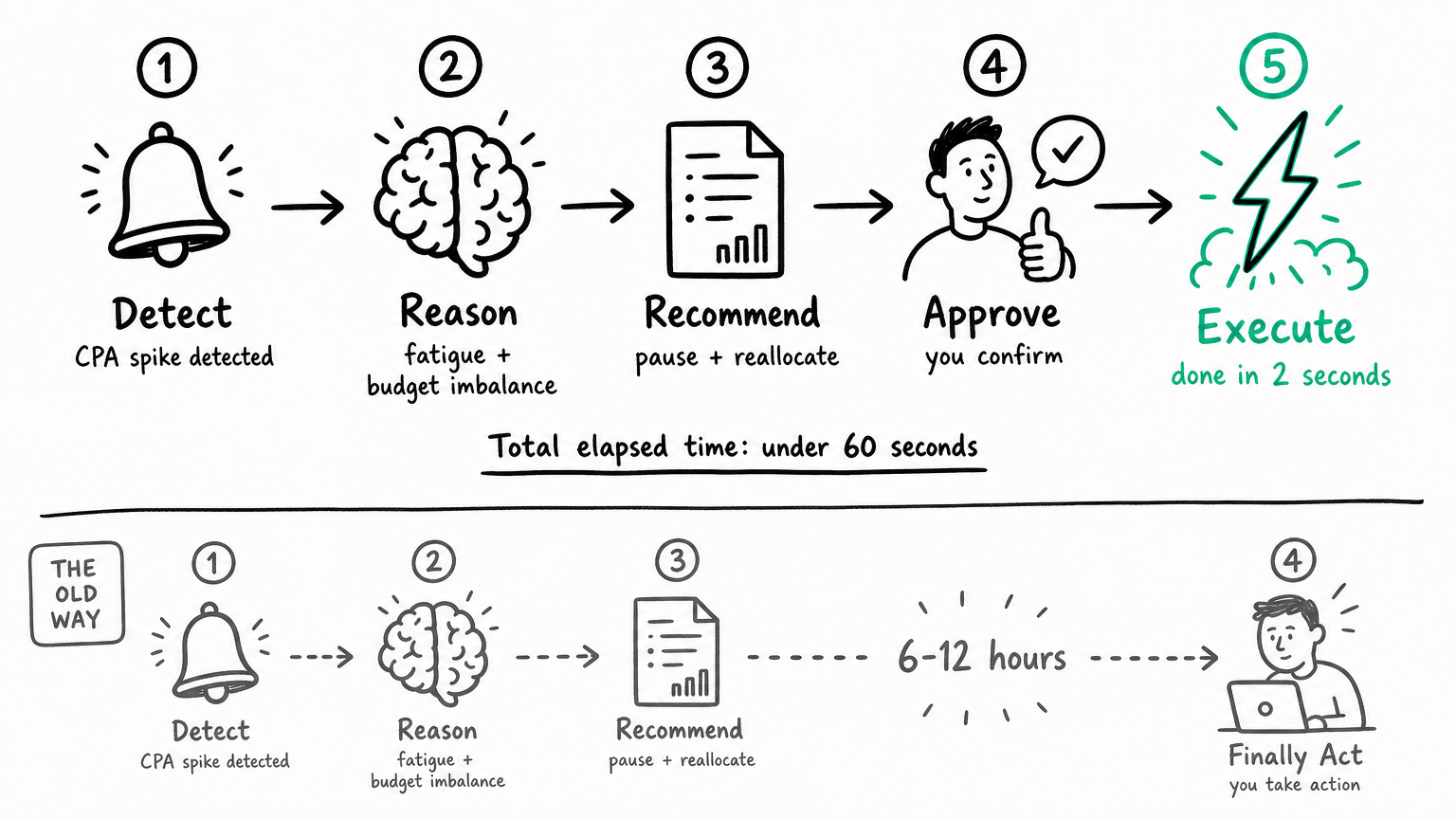
We don't fabricate client data. Below are scenario descriptions of what GrowthGPT actually does:
Scenario 1: 3 AM — CPA Spikes
You're asleep. GrowthGPT isn't.
The system detects an Ad Set's CPA exceeding threshold for 2 consecutive hours. Rule fires: pause that Ad Set, reallocate budget to the day's highest-ROAS group.
Next morning you open the dashboard. Money didn't burn. The good Ad Set got the extra spend.
Time zones don't fix themselves. Rules do.
Scenario 2: Day 5 — Creative Fatigues
Frequency hits 3.2. CTR drops from 1.8% to 0.9%. The old workflow: wait for someone to notice → brief the designer → wait for new assets → upload → build new ad. Two days minimum.
GrowthGPT flags the fatigue same-day → generates image variants with AI → builds the new ad → queues it for your approval → you tap once and it's live.
Creative throughput isn't a design-team overtime problem. It's an automation problem.
Scenario 3: New Product Launch — Cold Start
Building a full Campaign structure from scratch takes 30–60 minutes: objective, audience, creatives, copy, budget. Launch three products in a day and half your morning is gone.
GrowthGPT drafts the Campaign structure from your product page and historical data. You review, approve, publish.
The first step of scaling shouldn't be manual labor.
Product Capabilities: What GrowthGPT Can Actually Touch
All operations are human-in-the-loop — the system proposes, you approve, then it executes.
| Capability | Meta | TikTok | |
|---|---|---|---|
| Adjust budgets | ✓ | ✓ | ✓ |
| Adjust bids / ROAS targets | ✓ | ✓ | ✓ |
| Pause ads / Ad Sets / Campaigns | ✓ | ✓ | ✓ |
| Enable ads / Ad Sets / Campaigns | ✓ | ✓ | ✓ |
| Create new ads / Campaigns | ✓ | ✓ | ✓ |
| Keyword management | — | ✓ | — |
| Creative upload & replacement | ✓ | ✓ | ✓ |
| AI-generated ad images | ✓ | ✓ | ✓ |
| Scheduled tasks | ✓ | ✓ | ✓ |
| Custom rules (conditional triggers) | ✓ | ✓ | ✓ |
Safety & Control
The biggest concern with an execution layer isn't "can it do things." It's "do I trust it to."
GrowthGPT's answer:
- Every action requires approval. The system never touches your account without confirmation. The flow is always: recommendation → you approve → then it executes.
- Role-based permissions. Who can view, who can approve, who can modify — your company decides.
- Full audit trail. What changed, why, who approved it. Every action is traceable.
- Kill switch. One click pauses all automation, instantly.
People move up, not out. Media buyers go from "manually tweaking parameters" to "approving AI-proposed plans" — spending their time on strategy instead of button-clicking.
FAQ
Q1: Is GrowthGPT just another AI dashboard?
No. Dashboards are the insight layer — they show you data. GrowthGPT is the execution layer — it goes into your ad accounts and makes changes. The difference: it doesn't just show you what to do. It does it.
Q2: Will it spend my money without asking?
No. Every budget change requires your approval (or the approval of whoever you designate). You can also set guardrails — e.g., no single budget adjustment exceeds 20%. The system has no authority to spend on its own.
Q3: How is this different from Meta / Google's native automated rules?
Three ways: ① Cross-platform — native rules only work within their own platform; GrowthGPT manages Meta + Google + TikTok from one place. ② Contextual intelligence — not simple if-then logic; it understands whether a CPA spike is from creative fatigue or audience saturation. ③ Full execution — it doesn't just send you a notification; it actually makes the change.
Q4: How long does setup take?
Authorize your ad accounts via OAuth. Takes minutes. No SDK, no code changes, no IT involvement. Authorize today, use today.
Q5: What team size is this for?
Most impactful at $50K+ monthly ad spend. If you run one platform and spend a few hundred dollars a day, manual management is fine. But the moment you're cross-platform, multi-account, or your team can't cover daily optimization across every account — the ROI of an execution layer becomes obvious.
What's Next
The last decade of growth tools was a race to see more clearly. The next decade is a race to act faster.
The first wave of AI helped marketers understand performance. The next wave helps them change it.
Related reading: