AI Ad Optimization in 2026: The Shift From Analysis to Execution
Ad platforms have automated bidding and targeting — the new optimization surface is creative quality and speed of execution. Why most AI tools stop at insights, and how closed-loop systems close the loop.
TL;DR
- Ad platforms have automated bidding, targeting, and delivery. The optimization surface has moved.
- Creative quality drives ~56% of digital campaign performance. But knowing that and acting on it are two different problems.
- Most AI ad tools are excellent at identifying opportunities — and then hand you a to-do list to implement them manually.
- A new category is emerging: closed-loop systems that detect, decide, and execute inside the ad account. No handoff. No lag.
- If your AI tool still requires a human to copy-paste its recommendations into Ads Manager, it's not optimizing. It's narrating.
The Highest-Paid Person on Your Team Is Manually Pausing Ads
How many hours per week does your most experienced media buyer spend inside Ads Manager — pausing fatigued creatives, nudging budgets, screenshotting performance charts for a Slack thread?
If the answer is more than five, your "AI optimization stack" may be optimizing the platform's job — bidding, targeting, delivery — while leaving your job completely untouched.
That gap is what this article is about.
AI Already Runs the Auction
For years, performance teams invested heavily in bid strategies, audience layering, and campaign architecture.
Today, the platforms have absorbed that work entirely.
- Meta continues expanding automation through Advantage+ and its Andromeda recommendation engine — a 10,000× model capacity increase that personalizes delivery at a scale no human media buyer can replicate.
- Google increasingly funnels advertisers toward Performance Max, where audience signals, placements, and bids are all algorithmically managed.
- TikTok automates significant portions of delivery through Smart Performance Campaigns and GMV Max.
The result is a structural shift:
The areas where advertisers once spent most of their optimization effort are no longer the areas where they create the most leverage.
The question has changed. It's no longer:
"How do I out-optimize the platform's bidding?"
It's increasingly:
"How do I feed the platform better creative inputs — and react faster when performance changes?"
Why Creative Has Become the Primary Performance Lever
Multiple independent studies point to the same conclusion:
| Source | Finding |
|---|---|
| Nielsen / NCS meta-study (MarketingCharts) | Creative quality contributes 56% of digital ad sales lift |
| MAGNA × Yahoo (Madison & Wall) | Creative accounts for 56% of purchase intent |
| Google internal research (Meta for Business) | Creative influences up to 70% of campaign success |
The exact percentages vary by methodology. The broader direction does not.
As bidding and targeting become commoditized, performance increasingly depends on:
- Creative quality — does the ad actually resonate?
- Creative diversity — does the algorithm have enough distinct inputs to learn from?
- Speed of iteration — how fast can you turn a winning insight into the next batch?
- Speed of execution — how quickly does a budget change or a pause actually happen once you know it's needed?
A winning ad discovered today loses value every hour that budget isn't reallocated. A fatigued creative identified on Monday keeps burning spend until someone manually pauses it on Friday.
The problem in most accounts isn't a lack of insight. It's a lack of operational speed.
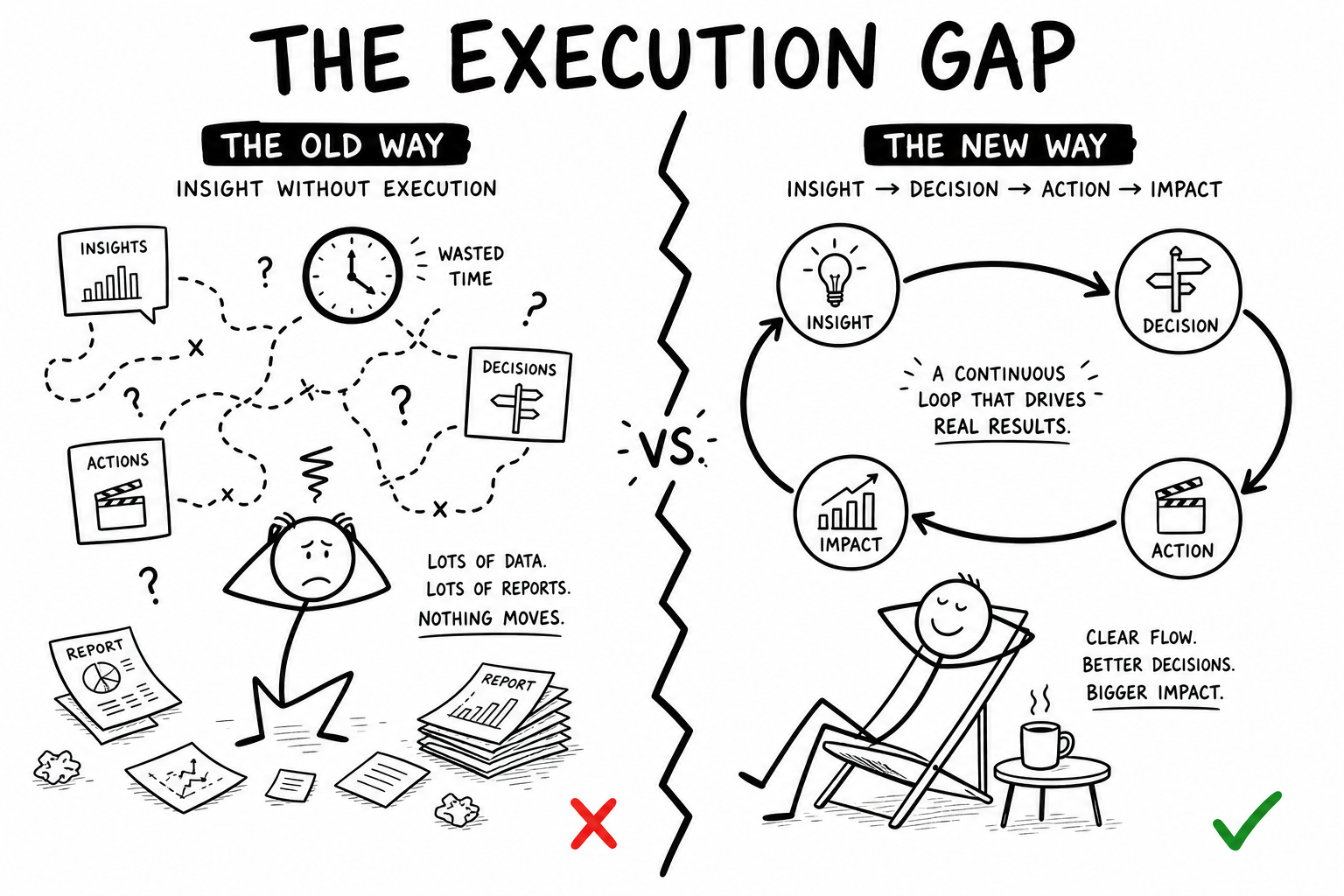
The Execution Gap Most Teams Still Live With
Modern marketing teams have no shortage of dashboards. In fact, many have too many.
Creative analytics tools identify fatigue. Reporting platforms surface anomalies. Attribution systems reveal shifting trends.
The insight layer is mature.
Yet a familiar workflow persists:
- An insight is discovered.
- A report is generated.
- A recommendation is shared in Slack.
- Someone reviews it.
- Someone else approves it.
- A media buyer implements it in Ads Manager.
- Results are evaluated days later.
Every handoff introduces delay. Every delay introduces opportunity cost.
The bottleneck is no longer information. It's the distance between information and action.
What Closed-Loop Optimization Actually Means
The next generation of advertising systems removes these handoffs.
Rather than stopping at analysis, they combine:
Detection → Decision → Execution → Learning
inside a single workflow.
The concept is straightforward:
- Detect a performance signal (fatigue, winner, budget headroom, underperformer)
- Determine the appropriate action (pause, scale, reallocate, iterate)
- Execute the action directly inside the ad account
- Learn from the outcome to sharpen the next cycle
Without requiring three tools, two meetings, and a media buyer to bridge the gap.
The distinction from traditional analytics may seem subtle. In practice, it's the difference between reading a weather forecast and having an umbrella that opens itself.
Because advertising performance compounds, shortening the interval between insight and action often creates more impact than generating better reports.
7 Areas Where Execution Matters More Than Analysis
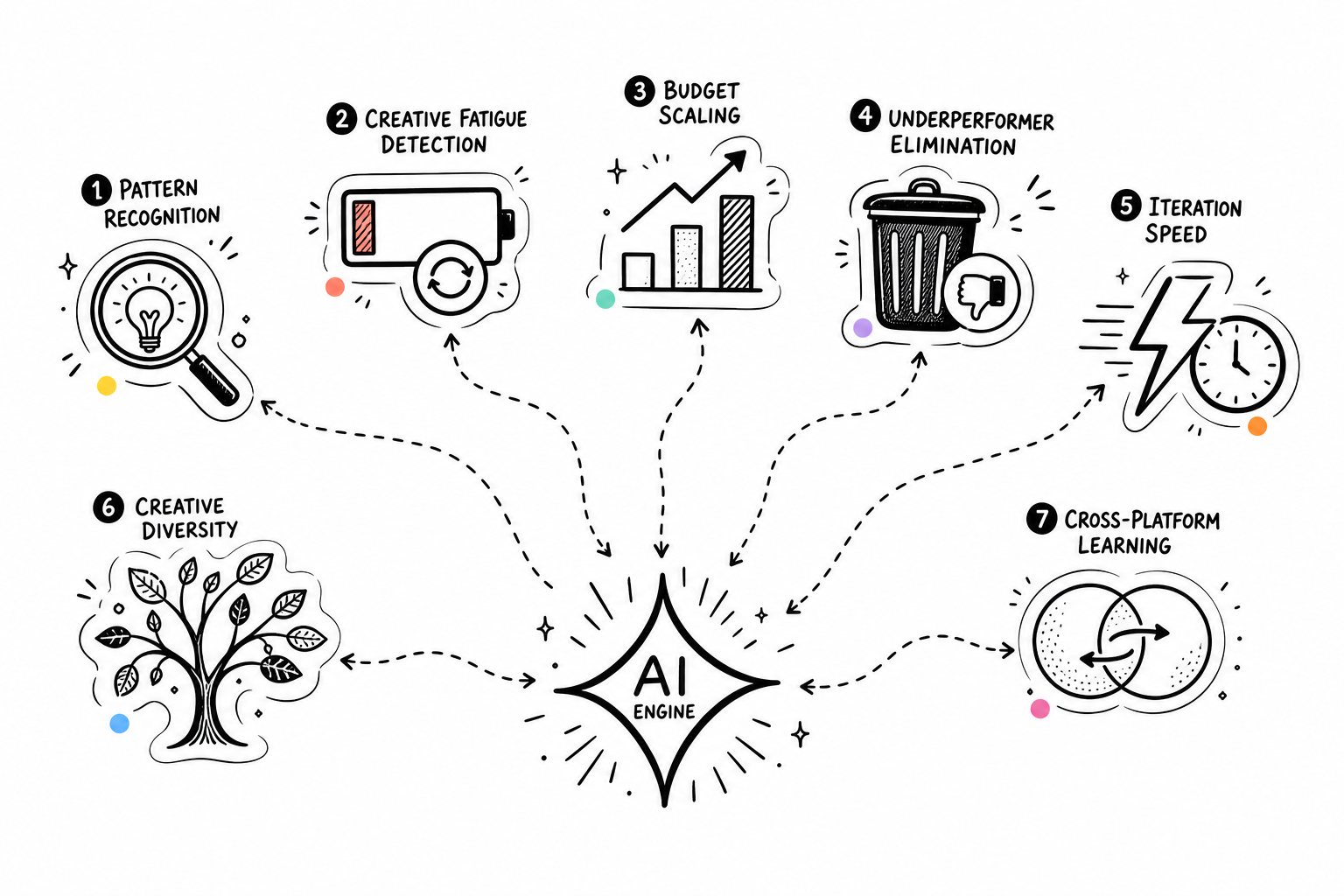
1. Creative Pattern Recognition → Production
The opportunity: AI tagging (computer vision + NLP) can decompose every ad into structural elements — hook type, messaging angle, visual format, CTA placement, emotional register — and surface which patterns drive results across hundreds of assets.
Where most tools stop: A labeled library. A "top performers" leaderboard. A report you forward to your creative team with a note saying "more like this."
What closed-loop looks like: The system identifies that problem-first hooks outperform benefit-first hooks by 2× on CPA for your account. It flags the underperforming cohort for pause. It generates new static creative concepts built around the winning pattern. It creates the ad within the existing Campaign. One confirmation. Done.
GrowthGPT does this across Meta, TikTok, and Google Ads — the same semantic creative analysis that standalone analytics tools provide, plus the execution layer they don't.
2. Creative Fatigue: Detection vs. Resolution
The opportunity: Fatigue isn't a single event. It's a compounding decay — declining CTR, rising frequency, weakening engagement — that often manifests at the category level before individual ads visibly collapse. When 80% of your active creatives share the same hook structure, the theme exhausts the audience as a group.
Where most tools stop: A score goes red. A "fatigue alert" email arrives. Someone adds "brief new creative" to next sprint's backlog.
What closed-loop looks like: The system monitors leading indicators across dual time windows (short-term for rapid signals, mid-term for confirmation). When both windows confirm fatigue: the ad is paused, budget redistributes to surviving performers, and if new assets exist in your library, a fresh ad is created within the existing structure — all before CPA visibly spikes.
GrowthGPT's optimization engine runs exactly this logic. On TikTok GMV Max, it can go one level deeper: identifying and excluding specific video creatives within a Campaign that are dragging down blended ROAS — surgical removal without killing the entire Ad Set.
Go deeper → We wrote a full breakdown of why detecting creative fatigue and resolving it are two fundamentally different problems — and why tools that only solve the first half are handing you an expensive to-do list.
3. Budget Scaling: Hours, Not Days
The opportunity: When a Campaign consistently outperforms your CPA or ROAS target across both a 3-day and 7-day window, every hour of delay in scaling its budget is unrealized revenue.
Where most tools stop: A notification: "Campaign X is below target CPA." The media buyer checks it at 9 a.m., raises the budget by $20, goes to their next meeting.
What closed-loop looks like: The system evaluates every active Campaign against its CPA target and preset budget ceiling. When dual-window performance confirms strength, it proposes a specific budget increase (calculated, capped, controlled). One approval click. Published.
GrowthGPT does this on Meta and TikTok today. Budget increases are bounded by user-defined ceilings — the system can't run away with spend, but it also doesn't wait for Monday's standup.
4. Underperformer Removal: Surgical, Not Blunt
The opportunity: Weak ads don't just waste their own budget. In broad-targeting environments (Advantage+, PMax, GMV Max), they steal delivery from stronger creatives while the algorithm is still learning.
Where most tools stop: A weekly report shows one ad with $300 spend and zero conversions. Someone pauses it. Eventually.
What closed-loop looks like: A spend-vs-results threshold triggers at the ad level. When an ad has spent significantly above target CPA with zero or poor conversions — confirmed across dual time windows to avoid premature kills — it's surfaced for pause. One click. Gone. Delivery share immediately flows to surviving winners.
On TikTok GMV Max, GrowthGPT can exclude individual video creatives from a Campaign — removing the drag without disrupting the broader Ad Set's learning.
5. Iteration Velocity: From Insight to Live Test
The opportunity: High-performing creative teams don't rebuild from scratch. They identify what's working and systematically iterate on specific variables: different hook, same format. Same hook, different visual. AI pattern recognition makes the "identify" part dramatically easier. But the time from insight to live test is still measured in days for most teams.
Where most tools stop: "Here's what's winning. Go brief your designer."
What closed-loop looks like: The analysis layer identifies the winning axis. The creative engine generates new static concepts around that axis. The campaign creation flow places the new creative into a live test structure. One workflow. No tool-switching. No context lost between "insight" and "action."
GrowthGPT connects creative analysis, AI creative generation, and campaign creation across Meta, Google, and TikTok into one continuous loop.
6. Creative Diversity Mapping
The opportunity: Platform algorithms (Andromeda, PMax, GMV Max) learn fastest when they receive genuinely diverse inputs — different angles, formats, and hooks. Twenty minor copy variations of the same concept provide less signal than five truly distinct creative approaches.
Where most tools stop: A cross-platform dashboard shows what's running on each channel. You figure out the gaps yourself.
What closed-loop looks like: The system maps which creative dimensions are saturated vs. under-explored across your entire multi-platform portfolio. It identifies coverage gaps. It proposes — and can produce — the creative diversity the algorithm needs, rather than relying on your team to intuit it.
GrowthGPT's cross-platform creative insights engine makes this mapping automatic. Combined with AI creative generation and multi-platform campaign creation, coverage gaps become immediately actionable.
7. Cross-Platform Learning Transfer
The opportunity: Patterns discovered on one platform frequently transfer to others. A hook style crushing on TikTok often works on Meta Reels. A PMax headline theme can inform YouTube ad scripts.
Where most tools stop: Multi-platform dashboards exist. Manually replicating learnings across three different ad managers does not scale.
What closed-loop looks like: Insights from one platform are immediately actionable on others through a single interface — same creative analysis, same execution capabilities, same campaign creation flow. No re-uploading. No rebuilding from scratch in a different tool.
GrowthGPT connects Meta, Google, and TikTok with both read and write access. Cross-platform learning isn't just visible — it's executable.
A Day in the Life: Traditional vs. Closed-Loop
| Time | Traditional workflow | Closed-loop workflow |
|---|---|---|
| Monday 9 AM | Weekly report shows 3 fatigued creatives, 1 strong performer, 2 budget-constrained winners | System already flagged these Friday evening |
| Monday 11 AM | Team meeting to discuss findings | Fatigued ads were paused Friday night. Budget already reallocated. |
| Tuesday | Creative brief sent to design team | New creative concepts generated from winning patterns |
| Wednesday | Media buyer adjusts budgets for winners | Budget increase was live since Saturday morning |
| Thursday | Design team returns with first drafts | New ads already live and accumulating data |
| Friday | New creatives uploaded, campaigns restructured | First iteration cycle complete. Second cycle beginning. |
Net difference: ~5 days of execution lag eliminated. At $500/day in ad spend, that's $2,500 in unoptimized delivery per weekly cycle — per account.
The value of closed-loop isn't a single dramatic optimization. It's faster compounding. Every cycle's learnings inform the next. The gap between teams with this velocity and teams without it widens every week.
The Conventional Wisdom That's Becoming Outdated
There's a common refrain in the AI advertising space:
"AI handles the speed, but strategic clarity still comes from humans."
It sounds reasonable. It's also increasingly a way for tools to explain why they stop at analysis.
Let's separate what's true from what's outdated:
Still true: Humans are irreplaceable for brand positioning, offer strategy, market timing, creative direction, and long-term business goals. AI shouldn't be making those calls.
Becoming outdated: The idea that deciding "pause this ad" or "increase this budget by 20%" requires human strategic judgment. Those are execution decisions with clear, quantifiable criteria. When the data says an ad has spent 3× target CPA with zero conversions, "pause it" isn't strategy. It's arithmetic that shouldn't wait for a human's calendar to open up.
The real shift: Closed-loop AI doesn't eliminate the need for human judgment. It changes where human judgment creates value. Less time operating systems. More time defining what success looks like.
The future isn't AI replacing marketers. It's marketers spending their hours on work that actually requires a human — and letting the system handle the execution that doesn't.
How GrowthGPT Fits Into This Shift
GrowthGPT was built around a straightforward observation:
Most advertising tools are optimized for delivering insights. Few are optimized for delivering outcomes.
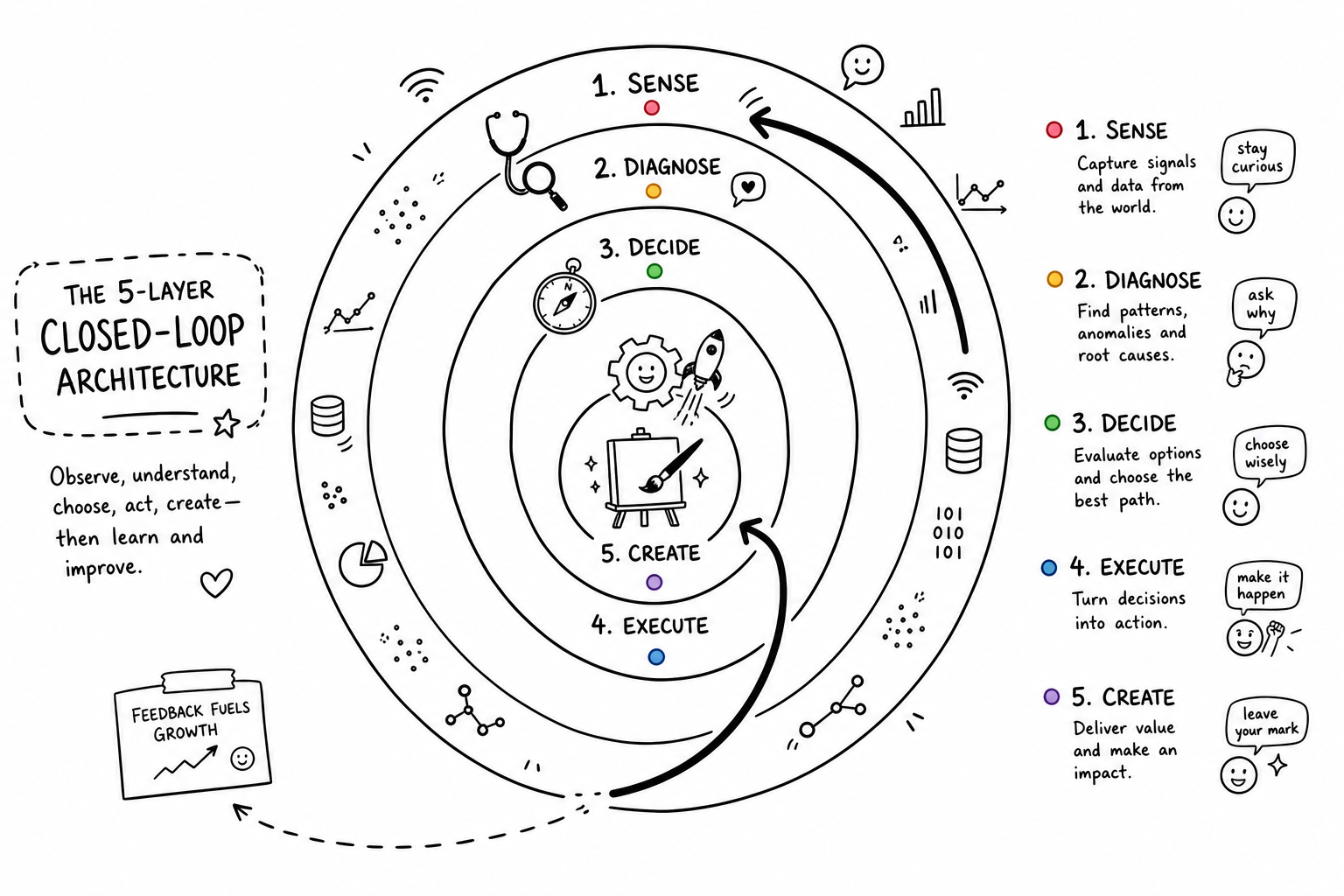
The Architecture
| Layer | What Happens | Mechanism |
|---|---|---|
| Diagnose | Cross-platform creative + performance analysis | Semantic query engine across Meta, Google, TikTok — Campaign, Ad Set, ad, and creative-level. Dual-window evaluation (3d + 7d). Winner / weak / fatigue classification. |
| Decide | Rule-based + AI-driven recommendations | CPA/ROAS target comparison, spend-rate thresholds, fatigue scoring, budget ceiling logic. Surfaces specific proposed actions with supporting data. |
| Execute | Direct mutations on live ad accounts | Budget increases, ad pauses, bid adjustments, ROAS target changes, creative exclusions, campaign creation. One-click approval → published. |
| Create | AI-powered creative production | The built-in creative engine produces ad creative concepts (static imagery) aligned with winning patterns — deployable into new or existing Campaigns. |
| Learn | Compounding optimization | Each cycle's results feed the next diagnosis. The system sharpens over time because it sees what it did, and what happened after. |
Platform Coverage
| Capability | Meta | TikTok | |
|---|---|---|---|
| Performance diagnostics (account → ad level) |  | | |
| Creative-level semantic analysis | | | |
| Auto-budget optimization (scale winners) | | — | (GMV Max) |
| Ad-level pause / creative exclusion | | — | |
| Bid & ROAS target adjustment | | | |
| Campaign creation | (all 6 objectives) | (PMax, Search, App) | (GMV Max, Auction) |
| AI creative generation | | | |
| Scheduled pause/activate | | | |
Early Results
Teams using GrowthGPT's closed-loop optimization have observed 15–30% reductions in effective CPA within the first 30 days — driven primarily by two factors:
- Faster budget reallocation to confirmed winners (hours instead of days)
- Faster removal of underperforming ads that silently cannibalize delivery share
These are conservative, directional numbers. The compounding effect — where each optimization cycle produces better inputs for the next — grows over time.
The Standard Is Shifting
The first generation of AI advertising tools focused on visibility. They helped marketers understand what was happening.
The next generation focuses on execution. It helps marketers act on what they already know.
That shift — from analysis to action — is becoming the defining line between tools that generate reports and tools that generate results.
Analysis alone is no longer enough. The standard has moved.
GrowthGPT sees it, and acts on it — in one closed loop.