Starting a TikTok Shop in 2026: Product Research, Margins, Creatives, and Ads
A step-by-step guide to starting a TikTok Shop business in 2026 — from finding products that aren't already crowded, stress-testing unit economics, producing testable creative, to running ads that compound.

Opening a TikTok Shop takes a day. Building one that still exists six months later is the hard part.
Most sellers don't fail because they picked the wrong trend. They fail because they never stress-tested the economics behind it — or they ran out of creative before paid ads could compound.
This guide is structured around that reality. The first half covers the analytical work: choosing a product, proving the margin survives, and making your listing competitive. The second half covers execution: content, creative production, and ads. If the first half isn't solid, the second half just burns cash faster.
Is TikTok Shop Right for You?
Honest answer: it depends on your tolerance for speed and margin compression.
What works in your favor:
- Built-in demand discovery. TikTok's content algorithm can surface a product to millions without an existing brand presence — no keyword ranking required.
- Native checkout means less drop-off. Users buy inside the app.
- The affiliate/creator ecosystem does distribution work for you — for a cut.
What works against you:
- Commission stacks up. Platform fees plus affiliate commissions consume a significant chunk of revenue before you count COGS or shipping.
- Returns are real. Categories like apparel and beauty see return rates that materially change unit economics.
- Speed cuts both ways. A product can blow up in a week and be commoditized in three. Moats are thin unless you own the brand or the content angle.
- You're competing for creator attention. If your commission isn't attractive or your product isn't easy to demonstrate, affiliates won't prioritize it.
If you're comfortable with thinner margins, faster cycles, and a content-heavy workload, TikTok Shop is genuinely one of the best places to build in 2026. If you need high margins and slow-burn brand equity, it may be a channel — not your entire business.
How TikTok Shop Is Different from Traditional Ecommerce
On Amazon or Shopify, the work centers on keyword ranking, review accumulation, and paid search. On TikTok Shop, the work centers on content and creator relationships.
| Traditional marketplace | TikTok Shop |
|---|---|
| Optimize listing SEO | Produce short-form video + product card images |
| Run search ads (PPC) | Run in-feed video ads + affiliate programs |
| Accumulate reviews over months | Get social proof via creator content in days |
| Conversion is search-intent driven | Conversion is impulse/entertainment driven |
The practical implication: if you can't produce or source video content regularly, growth stalls. The platform rewards fresh creative. Your org chart — even if it's just you — needs to reflect that.
Step 1: Pick a Product — Demand vs. Crowding
Most guides say "find a trending product." That's incomplete advice. What matters is the ratio between demand and competition density — specifically, how many affiliates are already promoting similar items.
A product with 20K weekly sales sounds great until you realize 400 creators are already pushing it. Your affiliate outreach will be noise. Your ad costs will be bid up. A product with 8K weekly sales and only a dozen active affiliates? That's where margin lives.
What to look for:
- Demonstrable value. Products that look different in motion (beauty transformations, cleaning gadgets, before/after) get organic reach because they make good content.
- Price range sweet spot. Impulse-buy territory (roughly $10–$45) works best for content-driven discovery. Below $10, margins vanish after fees. Above $50, the impulse conversion weakens.
- Not yet saturated. The question isn't "is anyone selling this?" but "is the affiliate pool already overcrowded relative to demand?"
The faster way: a best-sellers tracker with an opportunity score quantifies the demand-to-crowding ratio by category, updated weekly. A category opportunity radar visualizes which niches have rising demand but haven't yet attracted a crowd of affiliates — the low-crowding, high-demand quadrant is where the current openings sit.
Step 2: Stress-Test Your Margins — Before You Order Inventory
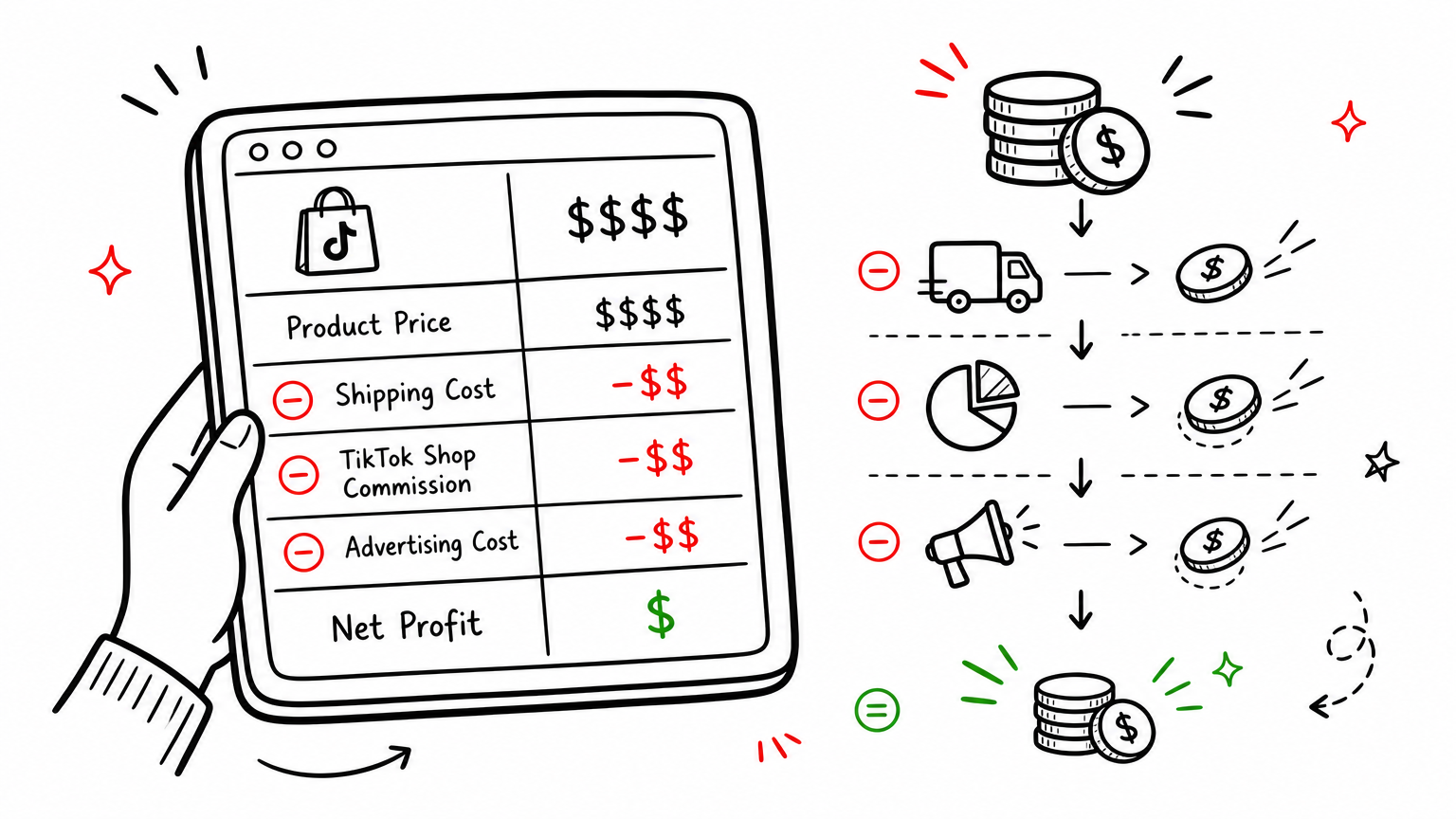
The number one mistake new TikTok Shop sellers make is calculating profit as selling price minus product cost. That math ignores:
- Platform commission (varies by category)
- Affiliate commission (what you'll offer creators)
- Shipping (first-mile + last-mile)
- Packaging
- Return rate (and what percentage of returns are unsalvageable)
- Ad spend per unit (once you move past organic)
A product that looks like a 40% margin play on paper often becomes a 12% margin play — or negative — once all fees are stacked.
How to think about it:
- Start with the realistic selling price (what's actually moving in the category, not your aspirational price).
- Subtract all costs: COGS, both legs of shipping, packaging.
- Subtract platform + affiliate fees (use category averages if you haven't locked rates yet).
- Apply a return rate assumption for your niche.
- Divide planned daily ad budget by expected daily unit sales to get ad cost per unit.
- What's left is your actual unit contribution margin.
If the margin doesn't survive this stack, find a cheaper source, raise the price (if the market allows it), or pick a different product.
The faster way: a free profit calculator built for TikTok Shop pre-fills category-average rates for platform fees and returns. The pre-filled figures are labeled as sample/category-average data — replace them with your real numbers before making a final call.
Step 3: Build a Listing That Can Compete
Your product card is where the sale happens — whether a viewer arrives from an ad, a creator video, or the Shop tab. Most new sellers treat listing images as an afterthought. That's a mistake when top sellers have invested in visuals that communicate value in two seconds.
What a competitive listing needs:
- Hero image: Product on a clean background. Size, material, and color immediately obvious.
- Benefit images (2–3): Each communicates one selling point — a visual argument, not a feature dump.
- Scale/context image: The product in use or in hand.
- Social proof image (optional): UGC or real reviews with photos.
Common failure modes:
- Using the same supplier photos every other seller uses. You look identical.
- Text-heavy images unreadable on mobile.
- Missing the "why this one?" angle in crowded categories.
This step is pure editorial judgment. No tool replaces the work of understanding why a buyer should pick your product over the seven others they'll scroll past.
Step 4: Content, Creators, and Competitor Intelligence
On TikTok Shop, organic content and creator partnerships aren't "nice to have" — they're the primary distribution mechanism. Paid ads amplify what's working, but without content that converts, there's nothing to amplify.
Creator/affiliate strategy:
- Start with micro-creators (1K–50K followers) in your product's niche. More responsive, cheaper, often higher engagement than macro influencers.
- Make it easy to say yes: free samples, a clear brief (not a script), competitive commission.
- Track which creators drive sales, not just views. A video with 500K views and zero conversions taught you something — but it's not a win.
Competitor intelligence:
Before you produce your own content or brief creators, study what's already running in your category. What hooks are working? What video lengths? What angles — unboxing, before/after, "TikTok made me buy it" format?
Most sellers either scroll TikTok manually or maintain an ad swipe file in a spreadsheet. Both approaches work at small scale — and both break once the category gets crowded and creative cycles compress to days rather than weeks.
What helps is anything that aggregates active competitor creative in one view: which ads are running now, which have been running longest (a proxy for performance), and what formats dominate. Whether you build that system manually or use a tool, the insight is the same — you want to know the current creative landscape before investing in production.
GrowthGPT's competitor ad analysis does this across TikTok and Meta if you want a structured shortcut.
Step 5: Produce Creative You Can Actually Test
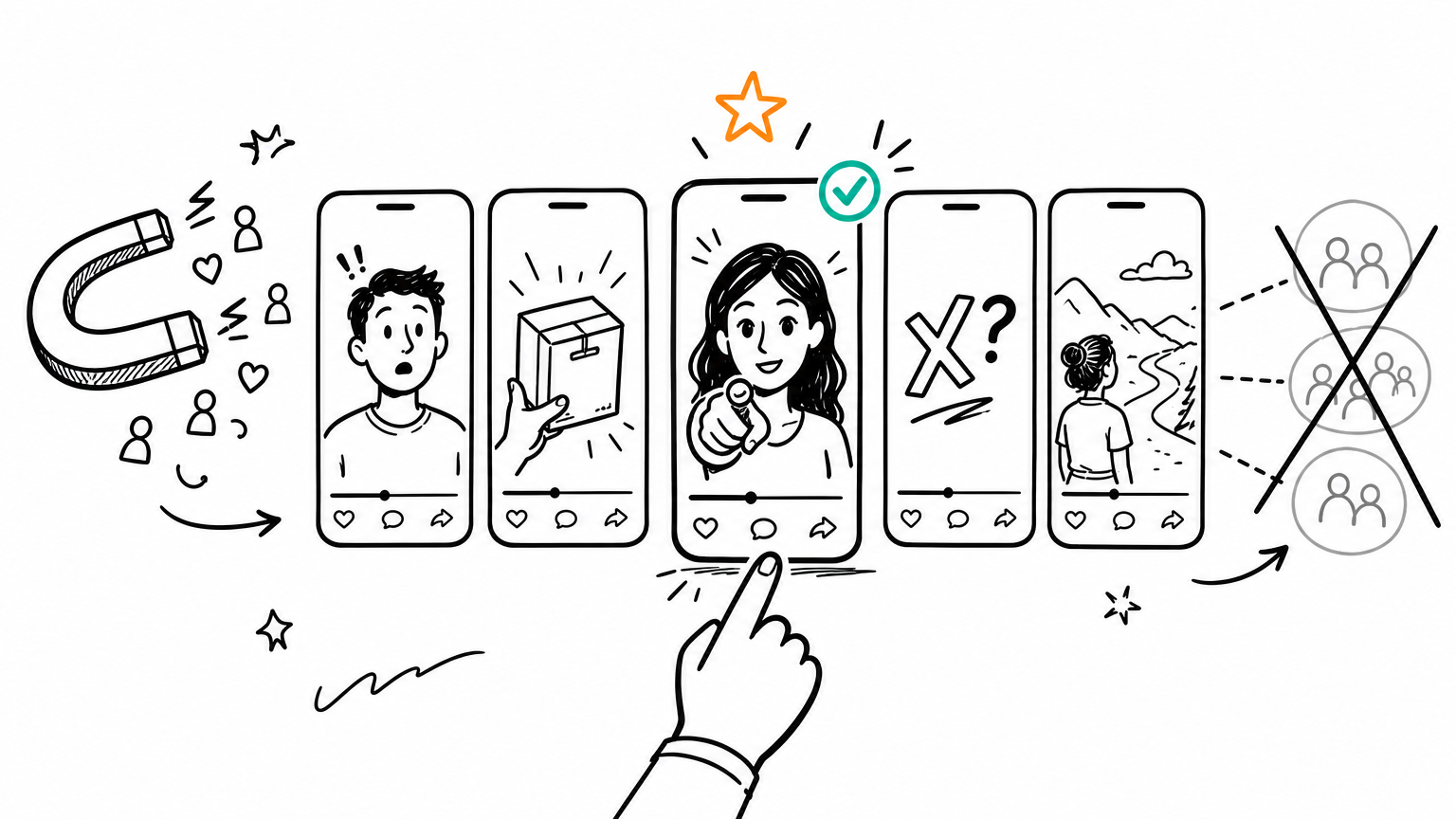
Here's where most sellers stall. They find a winning product, validate the margins, set up the listing — then get stuck producing ad creative. Either they're waiting on a freelancer, they have one video and no way to test variations, or they burn time learning editing tools.
The problem isn't creativity. It's throughput. Paid ads require testing: different hooks, different formats, different angles for different audiences. One asset isn't a test — it's a guess.
What "testable creative" means in practice:
- Multiple versions of the same concept (different opening hooks, different text overlays, different CTAs).
- Multiple formats for different placements (9:16 for in-feed, 1:1 for product cards, 4:5 for cross-platform).
- Rapid iteration based on performance data — not weeks-long production cycles.
What a high-performing TikTok Shop video looks like:
This is a 15-second AIGC product video for a setting spray. The structure is worth studying: a before/after transition hook (bare face → full makeup in a single hand-gesture cut), product application in context, a close-up texture shot, and a product reveal. No voiceover — the visual transformation does the selling. Under 15 seconds. One product moment. That's the format that converts on TikTok Shop: demonstrable, fast, built around visual proof.
Notice what's absent: no brand intro, no lengthy explanation, no lifestyle montage. The video earns attention in the first frame and delivers the product payoff within two seconds. That density is what makes it scalable as an ad — it doesn't need the viewer to commit 30 seconds before the value is clear.
On static creative: GrowthGPT's AI creative tool generates multi-version, multi-format ad images built around your product and selling points — structured for media-buying testing rather than generic design.
Step 6: Run Ads and Optimize Continuously

Once you have content that converts organically or through affiliates, paid ads become the multiplier. TikTok Shop Ads let you push proven creative to broader audiences and control spend.
How to think about paid on TikTok Shop:
- Start with what's already working. Your best-performing organic or creator video is your first ad candidate.
- Test hooks, not just audiences. Creative fatigue is real. The same video stops converting after a window. Budget for ongoing creative refresh.
- Watch the unit economics daily. Ad spend per unit has to fit inside the margin you calculated in Step 2.
- Scale cautiously. A good day doesn't mean 3x the budget tomorrow. Look for consistent 72-hour trends before increasing spend.
What "optimization" means daily:
- Checking which ad sets are above/below CPA targets.
- Pausing fatigued creative.
- Reallocating budget toward the best-performing combinations.
- Launching new creative tests to replace what's declining.
This is repetitive, signal-driven work. It benefits from systematic monitoring rather than sporadic check-ins — whether that's a disciplined morning routine or a system that watches for you.
GrowthGPT's ads agent handles this loop: it monitors campaigns against your targets, adjusts budgets, pauses underperformers, and launches tests — with logged reasoning and confidence levels for every action. You set the guardrails; every action is auditable.
Don't Ignore Retention
TikTok Shop sellers obsess over acquisition because it's visible. The quieter lever is repeat purchase.
If the economics only work when every sale is a first sale, you're renting growth. The margin math from Step 2 looks very different when a customer buys twice at zero acquisition cost.
Levers worth testing:
- Bundles and cross-sell. Surface the complementary SKU on your shop page.
- Replenishment. Consumables (supplements, beauty, food) can use subscribe-and-save mechanics where available.
- Off-platform capture. Package inserts with a QR code to a loyalty list or community move the customer to a channel you control.
Retention strategy on TikTok Shop is still evolving. The infrastructure isn't as mature as DTC email flows. But the sellers who think about it early build compounding economics rather than a treadmill.
The Setup Part: Store Registration, Compliance, and Logistics
We put this after the strategic steps intentionally. Registration is the easy part. If your product selection, margins, and content plan aren't solid, a registered store won't save you.
- Register on TikTok Shop Seller Center — business license (or individual ID in some markets), bank account, fulfillment method.
- Choose your fulfillment model. FBT (Fulfilled by TikTok) simplifies logistics but reduces margin. Self-ship gives control but requires fast processing. 3PLs are the middle ground for sellers past 20+ orders/day.
- Check compliance requirements. Supplements, beauty, and electronics may require additional documentation (FDA registration, certifications). Check TikTok Shop's restricted-products list before investing in inventory.
Setup steps change frequently. The official Seller Center documentation is always the most current source.
Bringing It Together
The mistake most new sellers make is treating TikTok Shop as a listing platform. It's not. It's a content platform with a checkout button.
The sellers who win aren't necessarily the ones with the cheapest products. They're the ones who can turn products into content, content into distribution, and distribution into repeatable economics.
The journey splits into two halves — and most sellers only do one well:
The analysis half (Steps 1–3): Pick the right product, prove the margin survives, build a listing that competes. Get these wrong, and no amount of ad spend fixes it.
The execution half (Steps 4–6): Produce content, generate testable creative, run and optimize ads at the pace the platform demands.
The gap between knowing what to do and actually doing it at speed is where most businesses stall. That's the gap GrowthGPT is designed to close — not by replacing the seller's judgment, but by compressing the execution cycle from weeks to hours.
FAQ
How do I start a TikTok Shop business with no experience?
Register on TikTok Shop Seller Center, pick a product using the demand-vs-crowding framework (Step 1), validate your margins (Step 2), and start small — one SKU, one market. You don't need prior ecommerce experience, but invest time understanding the platform's content-driven mechanics before scaling spend.
Do I need to run ads on TikTok Shop?
You can start organically through affiliate partnerships and your own content. Many sellers get first sales without ads. But organic reach is unpredictable and decays — once you've validated a product converts, paid ads give you control over scale and consistency. Ads are the accelerant, not the ignition.
How much money do I need to start?
You can technically start with just inventory cost — there's no platform fee to list. Realistically, budget for: initial inventory (test quantities), product photography or video, sample units for creators, and a small ad testing budget once you've validated demand organically. Many sellers start with a few hundred dollars for a single-SKU test.