GPT-5.6 Is Smarter. It Still Can't Run Your Ads.
GPT-5.6 narrows the reasoning gap. Advertising is blocked by the permission gap — here's why a smarter model doesn't close it.
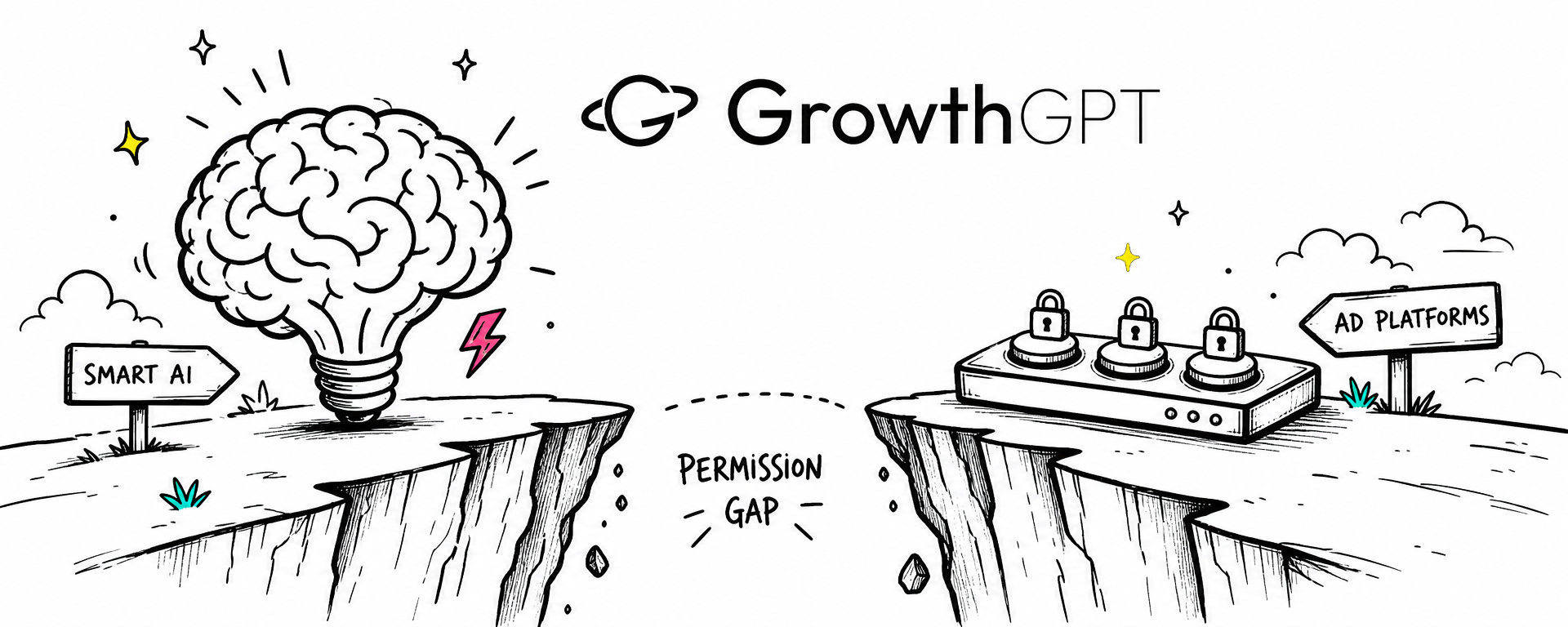
Every major model release creates the same illusion: the model got smarter, so it must be one step closer to replacing the specialist. It sounds reasonable — and it's exactly where people keep misdiagnosing the problem.
OpenAI shipped GPT-5.6 yesterday — stronger tool use, subagents, and a ChatGPT Work agent that builds documents and browses the web autonomously.12 Within hours, the question was everywhere: can I finally let ChatGPT run my ads?
TL;DR — Two gaps, not one.
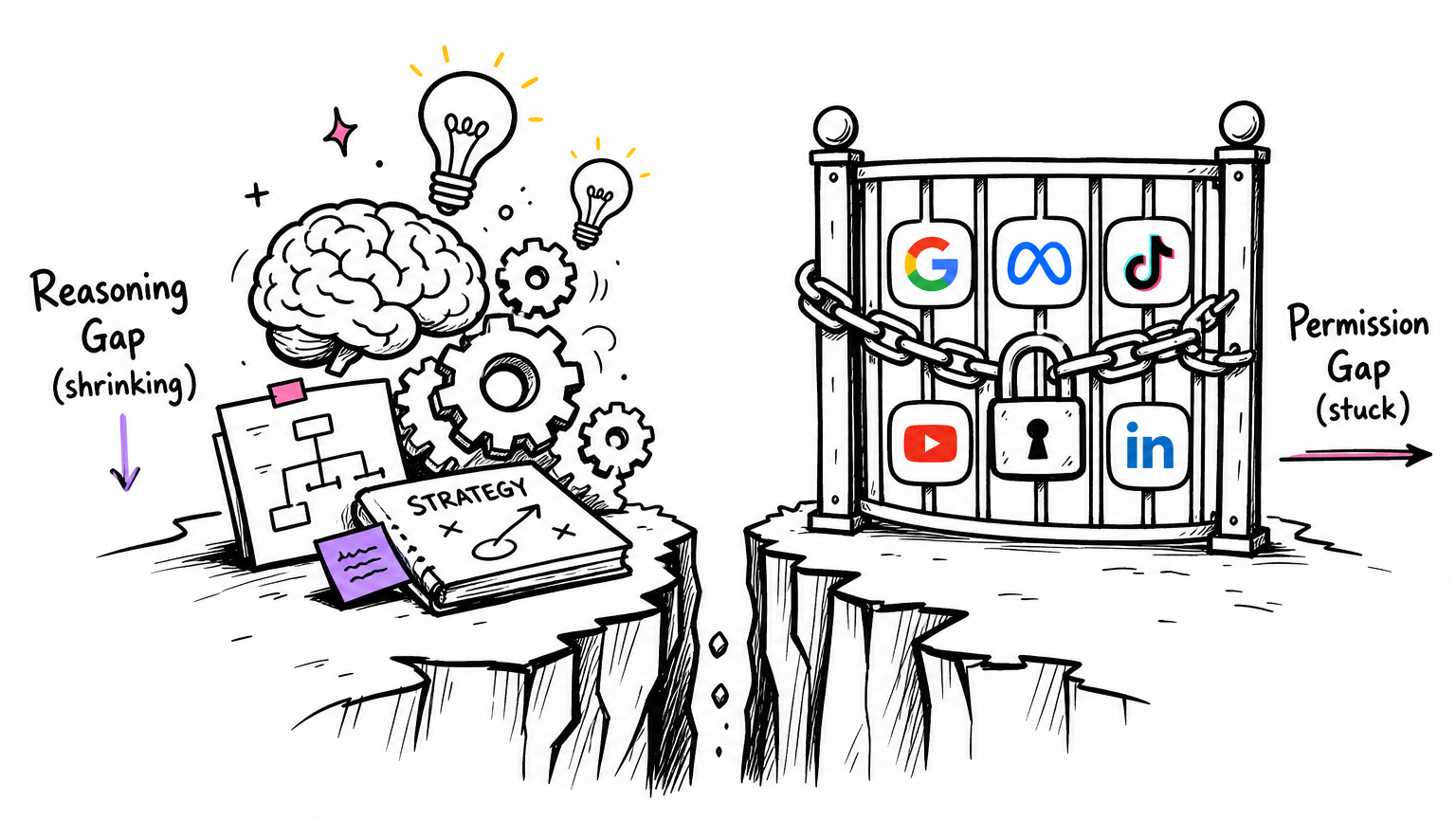
For years, AI has been closing the reasoning gap — GPT-5.6 closes it further. But running ads was never blocked by reasoning. It's blocked by the permission gap: the distance between knowing what to do and being allowed to do it, on live accounts, across platforms.
GPT-5.6 narrowed the first gap. It doesn't touch the second — and the second is where advertising actually lives.
Two kinds of work
Advertising splits into thinking and doing.
Thinking got dramatically better this week — drafting angles, reading performance, reasoning about a brief. Doing barely moved. And doing is where teams get stuck: getting creative live, changing budgets, pausing losers, coordinating across Meta, Google, and TikTok. (Long version: the four layers of advertising.)
A smarter model is a better thinker. It doesn't hand you a better doer.
The permission gap, in one sentence
GPT-5.6 can tell you to raise your Google budget 20% and pause three fatiguing Meta ads. It still can't press those buttons — legally — across Meta, Google, and TikTok.
Pressing the button needs four things a smarter model doesn't provide, and none of them are intelligence problems:
- Permission. Sanctioned, compliant write access to each platform. A brilliant model driving a browser around Ads Manager is the exact pattern platforms flag as unauthorized automation — and the accounts that try it get risk-controlled fast. A smarter model doesn't grant permission.
- Coordination. Whether tomorrow's dollar belongs on Meta or TikTok is an incentive-and-data problem, not a reasoning one. More subagents don't fix it.
- Memory. A model call reasons, answers, then forgets. Growth compounds only when the system remembers what you tested and logs what it changed.
- Trust. Smarter ≠ safer with live budget. Approval flows, guardrails, and an audit trail are what make action usable — and across the industry, trust is the top barrier to adoption, not capability.
The reasoning gap narrows with every release. The permission gap doesn't — because it was never about IQ.
Who actually benefits from a smarter model
Not necessarily the model companies. The teams that gain most are the ones that already hold the permission — that own execution across platforms and can turn a smart recommendation into a safe action.
That's why GrowthGPT exists: the cross-platform control layer that closes the permission gap. Compliant execution across Meta, Google, and TikTok. Persistent memory. Approval-first guardrails with a full audit trail. Plug a smarter model in and it gets better — because the brain improved and the permission was already there.
A better model doesn't make that layer obsolete. It makes it more valuable — the smarter the recommendation, the more everything comes down to whether anything is allowed to act on it.
What to remember next time a model drops
Every model release raises the ceiling on thinking. Permission decides who reaches it.
GPT-5.6 narrowed the reasoning gap. It didn't narrow the permission gap — and advertising was always a permission problem.
Next time, ask one question: did the release add permission — or just intelligence? That tells you whether anything actually changed for your ad operations.
FAQ
Can ChatGPT or GPT-5.6 manage my Meta ads? For thinking tasks — drafting, analysis, planning — yes, and it's better than before. For operating a live account, no: that requires compliant write access, guardrails, and memory that a general-purpose model doesn't have.
Can AI legally automate Ads Manager? Not via browser automation — platforms treat driving the UI as unauthorized access, and it's a fast path to enforcement. The compliant route is official API / MCP access with human approval in the loop, not a browser bot.
Can GPT-5.6 replace a media buyer? No — it shifts where their leverage is. Thinking gets automated; the human moves up to goals, guardrails, and the cross-platform calls no single model can make.
What is ChatGPT Work? OpenAI's new agent that gathers context across your apps and files, builds docs and spreadsheets, and browses the web. Excellent for thinking work; not built to operate live ad accounts across platforms.
A smarter model raises the ceiling on thinking. Advertising's ceiling was always permission.
→ See how the cross-platform control layer works
Footnotes
-
Axios — "OpenAI releases GPT-5.6 and ChatGPT Work tool" (July 9, 2026): https://www.axios.com/2026/07/09/ai-openai-gpt-release ↩
-
MarkTechPost — "OpenAI Releases GPT-5.6: stronger tool use, subagents, ChatGPT Work" (July 9, 2026): https://www.marktechpost.com/2026/07/09/openai-releases-gpt-5-6-a-three-tier-model-family-with-programmatic-tool-calling/ ↩