Loop Engineering Is a Start. Growth Systems Are the Destination.
The coding world named "loop engineering." But loops that iterate toward test results aren't the same as systems that iterate toward revenue. Here's the framework — and the level most AI products never reach.
TL;DR
In June 2026, developers named loop engineering — designing systems that prompt AI agents, verify results, and iterate toward goals. It's a real shift. But it's also incomplete. A loop that iterates toward "tests pass" and a system that iterates toward "revenue grows" are architecturally different things. This article introduces four levels of AI systems — and argues that the fourth, Growth Systems, is where the real value compounds.
Early June. A shift in language.
A group of engineers who build AI coding agents started saying the same thing within days of each other.
"I don't prompt Claude anymore. I have loops running that prompt Claude." — Boris Cherny, head of Claude Code at Anthropic.
"You shouldn't be prompting coding agents anymore. You should be designing loops that prompt your agents." — Peter Steinberger.
The next day, Addy Osmani formalized it: loop engineering is replacing yourself as the person who prompts the agent. You design the system that does it instead.
The coding world named it first. The concept matters. But there's a level beyond it that nobody's talking about yet.
The prompt ceiling
Here's what most AI workflows actually look like today:
You ask a question. You get advice. You do the work. You come back tomorrow and ask again — from scratch, because the system forgot everything.
The AI doesn't remember what it recommended yesterday. It can't check whether its last suggestion worked. It can't touch your ad account, your analytics, your creative pipeline. It can't keep running when you close the tab.
Prompts tell AI what to think. They don't tell it what to do next.
This is the ceiling. Not intelligence — continuity. Not insight — action.
Four levels of AI systems
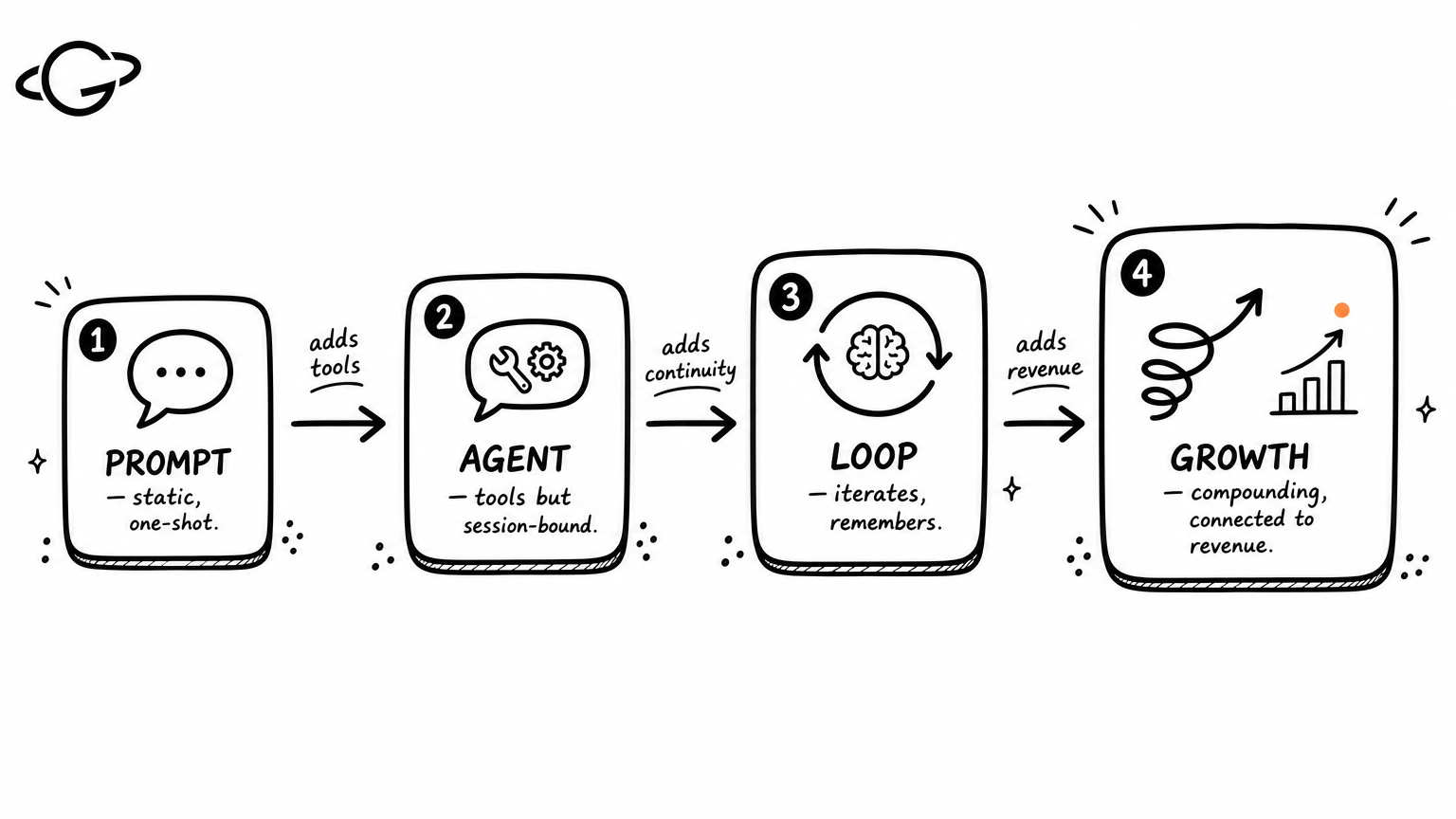
Not all AI products are built the same way. The difference isn't capability. It's architecture — and what the system iterates toward.
Level 1: Prompt Systems
You type. It responds. Session ends. No memory, no action, no iteration.
Most AI tools live here. Useful for one-off questions. They fail for anything that compounds.
Level 2: Agent Systems
The AI can use tools, follow multi-step plans, and connect to external systems within a single session. Better. But when the session ends, so does the work.
Many "AI agents" are actually Level 2 — capable inside a conversation, stateless across conversations.
Level 3: Loop Systems
The AI operates in cycles. It remembers across sessions. It acts on real systems. It verifies its own output through separate validation. It runs on schedules. It compounds.
This is what the industry just named "loop engineering." It's a genuine architectural shift. But there's a question it doesn't answer:
What is the loop iterating toward?
In the coding world, the answer is clear: tests pass, lint is clean, the PR is ready. Binary. Verifiable. Contained.
But business doesn't work that way.
Level 4: Growth Systems
A Growth System is what a loop becomes when it's attached to real business outcomes.
The iteration target isn't "condition met." It's "revenue moved." It's "CPA decreased while volume held." It's "the test that failed last week informed the strategy this week."
This changes what the system needs to do:
- It can't just verify — it needs to interpret. Did CPA drop because of the creative change, or because the competitor paused spend?
- It can't just remember — it needs to compound. Last week's failure isn't just stored; it shapes this week's hypothesis.
- It can't just act — it needs to decide under uncertainty. Markets shift. What worked yesterday may not work tomorrow.
- It can't just loop — it needs to know when to stop looping and escalate. Not every problem is solvable by iteration.
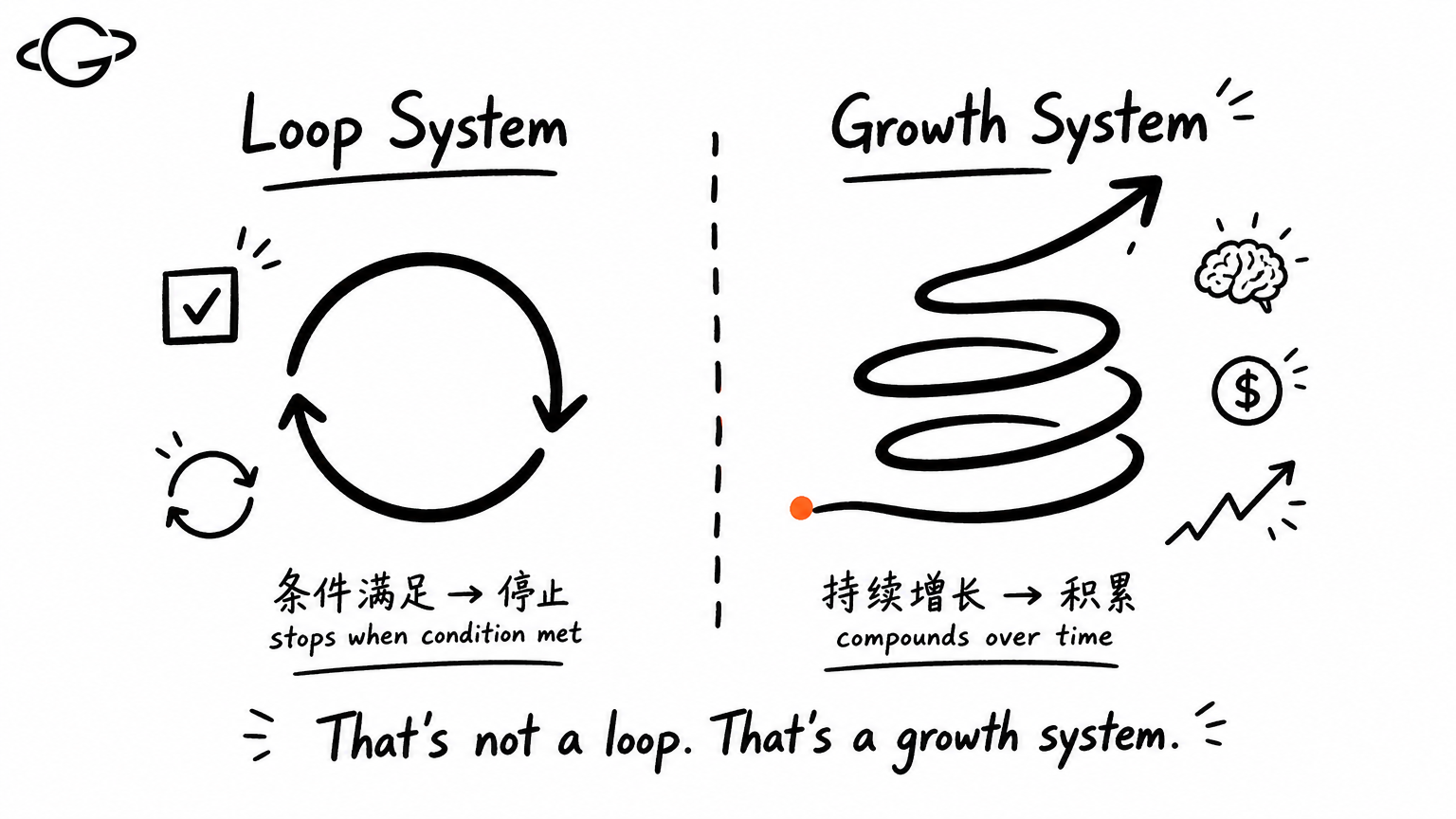
A loop system asks: "Is the goal met?"
A growth system asks: "Is the business better?"
That's not a semantic difference. It's a different class of system.
Why most loops won't become growth systems
The coding community solved loop engineering because their domain has a useful property: clear pass/fail signals. Tests pass or they don't. Lint is clean or it isn't.
Growth doesn't have that luxury. Growth lives in:
- Ambiguous causation. Did the budget change help, or did the market shift?
- Competing objectives. Lower CPA and higher volume? Those often fight.
- Non-stationary environments. The platform changed its algorithm Tuesday. Your loop didn't notice.
- Cross-system dependencies. Creative performance affects bidding. Bidding affects delivery. Delivery affects measurement. You can't loop on one without understanding the others.
A generic loop — even a well-designed one — will break on these problems. It'll iterate toward a local optimum and miss the strategic shift. It'll optimize a metric that stopped mattering. It'll keep running when it should escalate.
Growth Systems are loops that know how to operate in this kind of uncertainty. They're not just architecturally continuous. They're commercially intelligent.
The growth loop
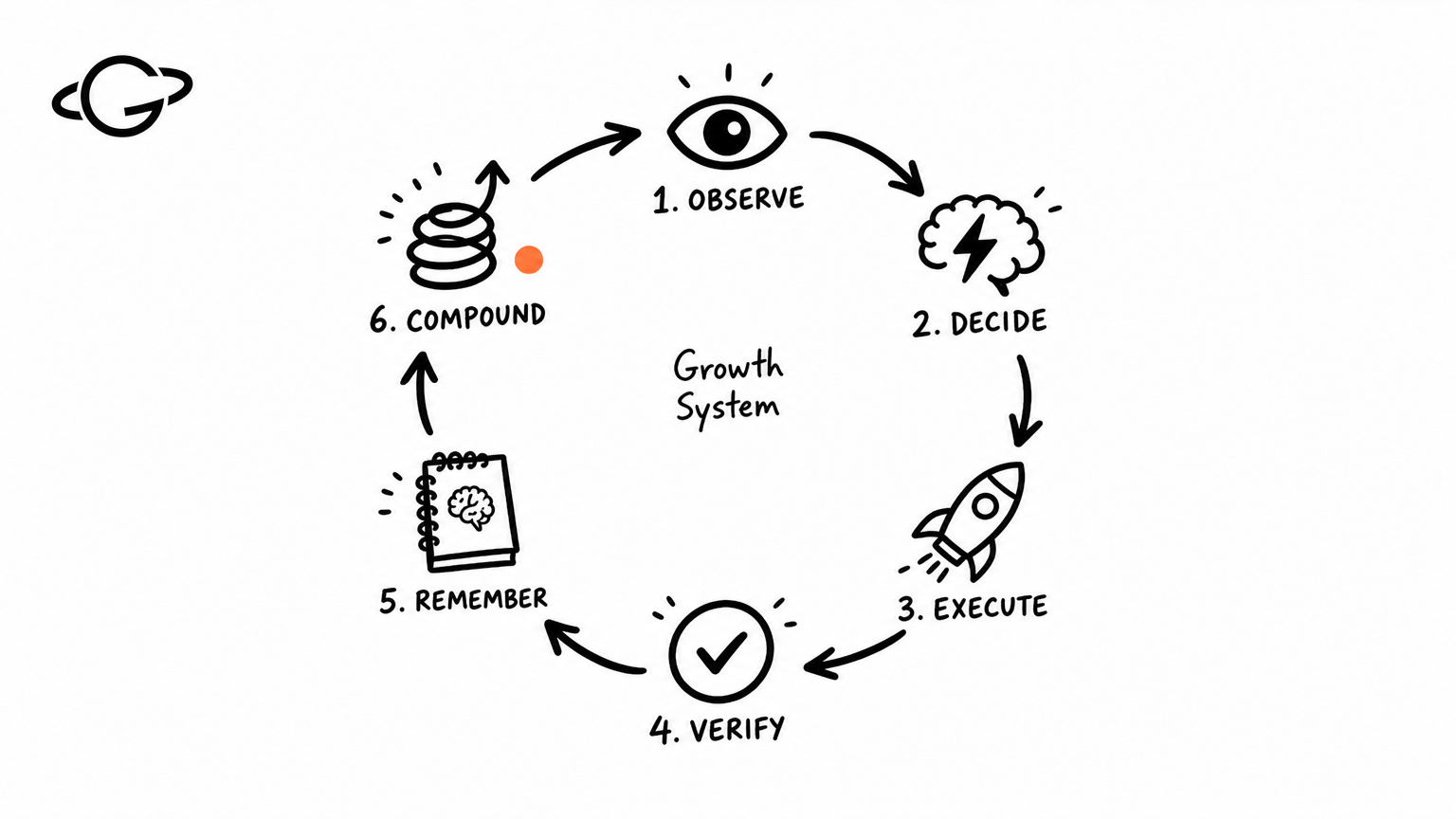
Map it:
Observe   → What's happening in the account, the market, and the creative?
Decide    → What should change — and what's the hypothesis behind it?
Execute   → Make the change on the real platform. Not in a doc.
Verify    → Did revenue move? Separate checker. Causation awareness.
Remember  → Store what happened. Update the model of what works.
Compound  → Next cycle starts smarter. Not from zero.
Most AI growth tools stop after "Decide." They generate a recommendation. You become the execution layer, the memory layer, and the verification layer — all at once.
A loop system does the full cycle. A growth system does the full cycle and knows what "better" means in business terms.
What makes a growth system different from a loop
| Property | Loop System | Growth System |
|---|---|---|
| Iteration target | Verifiable condition ("tests pass") | Business outcome ("revenue grows, efficiency holds") |
| Verification | Binary — pass/fail | Continuous — degree of improvement + confidence |
| Memory | What was done | What was done + what it meant + what to try differently |
| Decision logic | Follow the plan until done | Adapt the plan when the market shifts |
| Escalation | Stop when blocked | Stop when the problem exceeds what iteration can solve |
| Domain knowledge | Generic (any codebase) | Specific (platform mechanics, business model, competitive context) |
The pattern was already here
Naming a pattern is useful. It gives teams a shared vocabulary. But practitioners often arrive at the architecture before the name exists.
Context engineering was named in 2025. Teams had been doing it since RAG became standard. Harness engineering was named in early 2026. Loop engineering crystallized in June 2026.
Growth Systems don't have an industry name yet. But the architecture — persistent skills, platform connectors, verification layers, memory that compounds, scheduled automation, business-outcome iteration — has been running in production for months.
The question isn't whether loop engineering is real. It's whether your AI growth stack is actually a growth system — or just a loop that doesn't know what it's optimizing for.
→ Related: Why agents that remember outperform agents that don't
→ Related: The next category doesn't advise — it executes
What comes next
The AI industry spent two years teaching models how to think.
Then it taught systems how to iterate.
The next phase is teaching them what to iterate toward.
Not "tests pass." Not "condition met."
Revenue. Efficiency. Compounding advantage.
The industry is talking about loops.
We're interested in what loops become when they're connected to revenue.
That's not a loop.
That's a growth system.
From analysis to execution.
FAQ
What is a Growth System?
A Growth System is an AI system that operates in continuous cycles — observing, deciding, executing, verifying, and compounding — with real business outcomes (revenue, CPA, ROAS, retention) as its iteration target, not just technical pass/fail conditions.
How is a Growth System different from loop engineering?
Loop engineering designs systems that iterate toward verifiable goals. Growth Systems are a specific, harder class of loop: they iterate toward business outcomes under ambiguous causation, competing objectives, and non-stationary market conditions. They require commercial intelligence, not just architectural continuity.
What is loop engineering?
Loop engineering is the practice of designing systems that prompt AI agents on your behalf — with goals, verification, memory, and iteration — instead of typing each instruction yourself. The term was formalized in June 2026 by developers working with coding agents.
What are the four levels of AI systems?
Level 1: Prompt Systems (one-shot, no memory). Level 2: Agent Systems (tools + plans, session-bound). Level 3: Loop Systems (continuous cycles, memory, verification). Level 4: Growth Systems (loop architecture + business-outcome iteration + commercial intelligence).
Is this framework specific to advertising?
The Growth Systems concept applies to any domain where AI iterates toward business outcomes — advertising, revenue operations, retention, pricing. Advertising is a natural starting point because it produces continuous, quantifiable feedback.